
Four Orthodontic Auxiliaries: Lingual Buttons, Crimpable Hooks, Power Chains and Elastic Ligatures
Orthodontic auxiliaries are the supporting components that let a fixed appliance perform a specific mechanical task. They are not the main bracket system, the main arch wire or the hand instruments used to place and adjust them. Four common examples are lingual buttons, crimpable hooks, power chains and elastic ligatures. Each has a different job in treatment mechanics, and each is purchased, documented and stocked in a different way.
That distinction matters for clinics, distributors and procurement teams. An auxiliary may be a small item, but a vague catalogue description can lead to the wrong attachment type, the wrong wire compatibility or the wrong packaging format. This guide introduces the category, explains the basic purpose of each of the four products and shows how they differ from brackets, arch wires and orthodontic instruments.
Yortho is an orthodontic brand of YAM Global Limited with its own factory in Asia. Its product range includes brackets, buccal tubes, molar bands, auxiliary attachments such as lingual buttons and crimpable hooks, elastic ligatures and orthodontic pliers. The examples below use only the product names and facts available in the supplied reference material.
What counts as an orthodontic auxiliary?
An orthodontic auxiliary is a component that supports, redirects or completes the action of the main appliance. It may create an attachment point, apply or transfer elastic force, secure an arch wire or connect the wire to a bracket. The category is defined by function, not by size. A small elastic ring and a stainless-steel hook can both be auxiliaries because both change how force is delivered.
The category boundary is useful in procurement. Brackets, buccal tubes and bands are the main attachments bonded or cemented to teeth. Arch wires are the main force-generating wires that sit in the bracket slots. Orthodontic instruments are reusable tools such as pliers, cutters, tweezers and positioning gauges. Auxiliaries sit around this core: they are selected for a specific mechanical role and must match the main appliance they support.
Auxiliaries are not interchangeable. A lingual button is not a bracket. A crimpable hook is not a welded attachment. A power chain is not the same product as an individual elastic ligature. Treating all four as one generic accessory group can hide differences in material, dimensions, packaging and documentation.
Why the category is easy to misread
The word auxiliary is sometimes used loosely to mean any small orthodontic item. That loose usage creates two problems. First, clinical staff may expect one product to perform a task that belongs to another. Second, buyers may compare quotations without checking whether the quoted item is an attachment, an elastomeric consumable or a reusable instrument.
A clearer definition separates four questions: what the item attaches to, whether it is bonded, crimped, tied or supplied as a continuous chain, whether it is single-use or reusable, and what main appliance it is designed to work with. These questions are more useful than a generic accessory label because they lead directly to the specification fields a buyer needs to confirm.
The application context is also mixed. Orthodontic products are used in clinical and dental clinic environments and should meet normal disinfection, sterilization and handling requirements. Elastic ligatures are single-use consumables, while pliers are reusable instruments. That difference affects stock planning, reprocessing requirements and the way product documentation is reviewed.
Industry background: how auxiliaries fit the orthodontic supply chain
Orthodontic supply ranges are usually organised by product family. Yortho’s own range covers orthodontic supplies, pediatric dental products and dental laboratory appliances. Within orthodontics, the main appliance group includes brackets, buccal tubes and molar bands, while the auxiliary group includes crimpable hooks, lingual buttons and lingual hooks. The same manufacturer may also supply pliers, bracket positioners, force gauges and archwire formers as separate instrument categories.
This taxonomy matters because the evidence base is not identical across product families. International standards such as ISO 27020:2019 address brackets and tubes, and ISO 15841:2014 addresses wires. Those standards help buyers compare main appliance specifications. They do not replace an auxiliary-specific specification sheet for a lingual button, crimpable hook, power chain or elastic ligature. For those items, the buyer should ask for the manufacturer’s current product data, material statement, dimensions and packaging information.
Yortho operates its own factory in Asia and exports to more than 70 countries. Its stated certifications include ISO, CE under the EU MDR and FDA registration. Those company-level facts are relevant to supplier screening, but they do not by themselves prove that every item in a catalogue has the same regulatory status. Product-specific documents still need to be requested for the exact auxiliary under review.
Lingual buttons: attachment points on the lingual surface
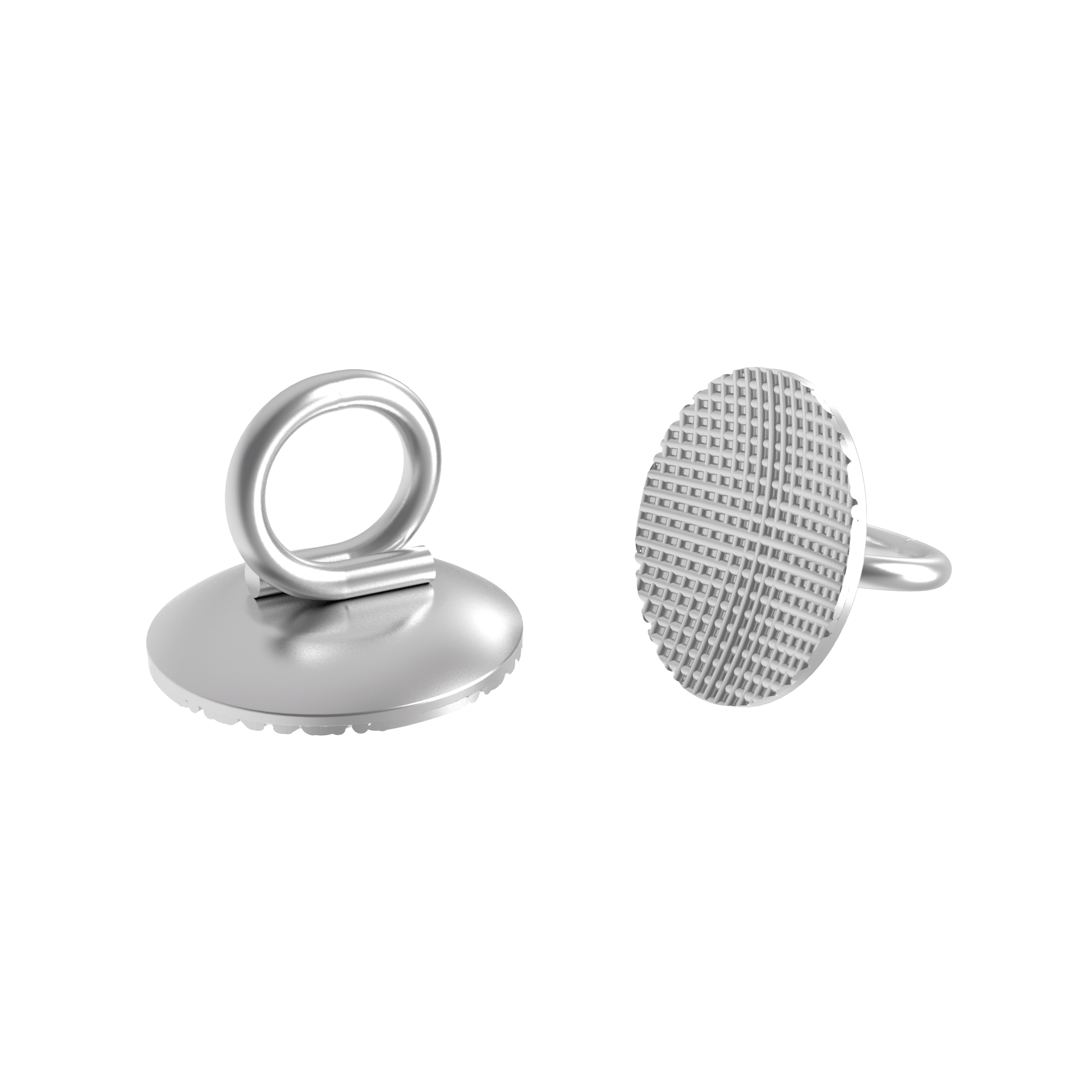
A lingual button is a small attachment bonded to the lingual surface of a tooth. Its basic purpose is to provide an attachment point for traction. It is not part of the main arch wire slot system, and it does not replace a bracket. It is selected when the treatment plan needs a secure point on the lingual side rather than on the buccal side.
The Yortho Y-F307 is listed as a bondable lingual eyelet with a round base and stainless-steel construction. Its supplied product description notes a mesh base for stable bonding, an upright ring to prevent slipping, a smooth polished finish and use in various orthodontic traction cases. These are product-level facts from the supplied reference material; they should not be extended into a claim that the same design is suitable for every patient or every bonding protocol.
For buyers, the useful checks are the base type, the ring shape, the material and the finish. A round base and a mesh bonding surface describe different parts of the product and should not be confused with the bracket base of a main appliance. If a clinic is standardising its auxiliary kit, it should also confirm whether the item is supplied as a single attachment or in a pack, and whether the packaging suits chairside handling.
Crimpable hooks: adding a hook where the arch wire needs one
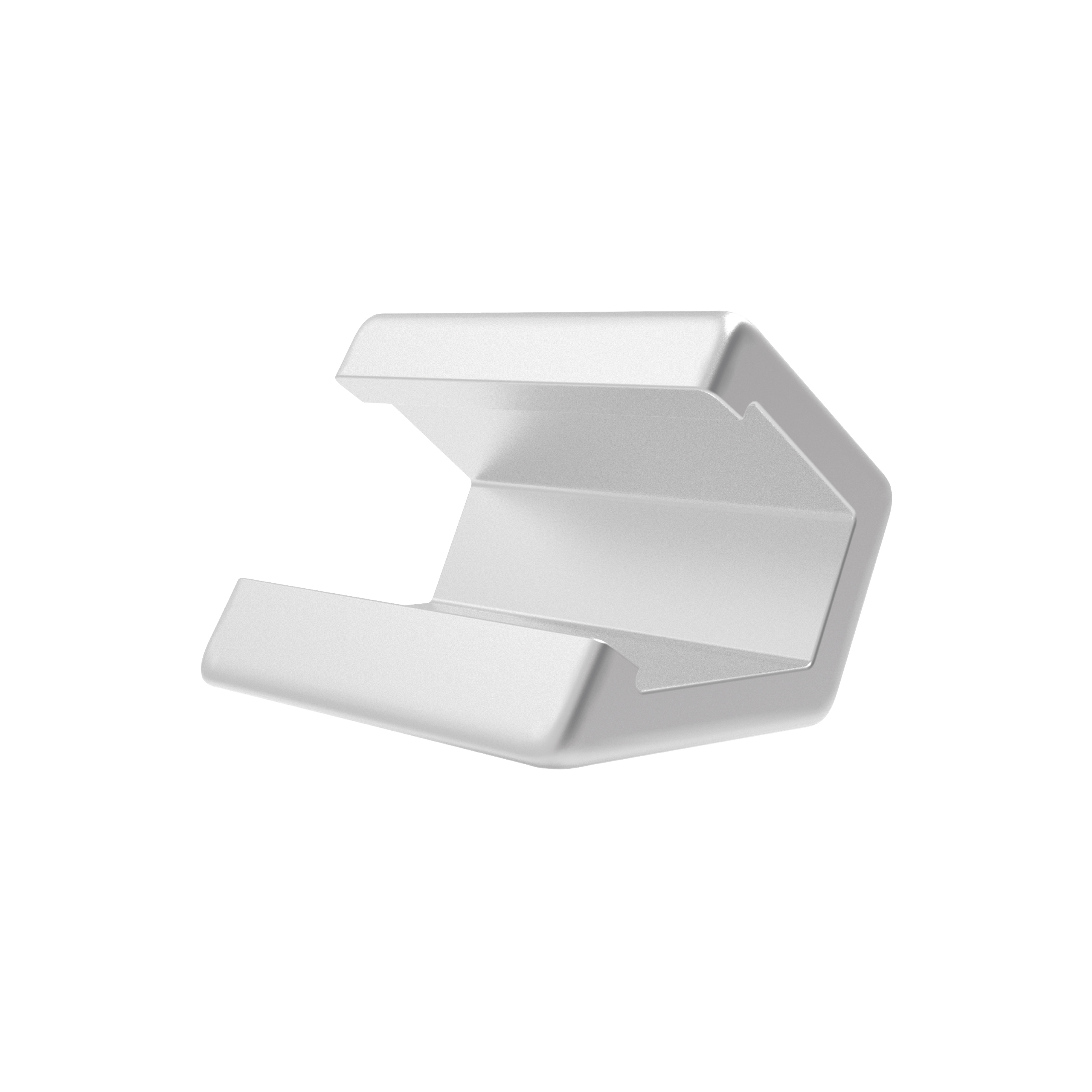
A crimpable hook is a small hook that is fixed onto an arch wire by crimping. It creates a point where an elastic or other traction element can be attached. The hook is not bonded to the tooth and is not a bracket. It belongs to the wire-side of the appliance because its position is set along the arch wire rather than on the enamel surface.
The Yortho Y-F201 is listed with a 0.022-inch size and a 2.4 mm type, in stainless steel. The supplied description highlights arrow-guided quick positioning, a firm anti-slip fit, corrosion-resistant medical steel, a rounded gentle surface and precise force delivery for fine orthodontic traction. These features describe the product design and intended handling; they do not establish a clinical outcome on their own.
A crimpable hook and a lingual button can look equally small, but they solve different problems. The button is bonded to a tooth surface; the hook is crimped to a wire. That difference affects inventory, because the buyer must match the hook to the wire size and confirm that the crimping action is secure. It also affects removal and replacement planning, because a wire-mounted item is handled differently from a bonded attachment.
Power chains: continuous elastomeric force for space closure
A power chain is a continuous elastomeric chain used as an auxiliary to deliver a light, continuous force across teeth, commonly in space-closure mechanics. It is different from an individual elastic ligature because it is supplied as a connected chain rather than as separate rings. It is also different from an arch wire: the arch wire is the main wire engaged in the bracket slots, while the power chain is an elastomeric auxiliary placed across selected attachments.
Yortho’s product range includes Orthodontic Power Chains under model Y-S80101. The supplied reference material for this article does not include dimensional or force specifications for that model, so this guide does not assign any. Buyers should request the current product sheet and confirm the chain format, link spacing, packaging and intended use before comparing quotations.
The procurement risk with power chains is not that the product is complex to describe. It is that catalogue abbreviations can hide differences between continuous chain, individual ligature and other elastomeric items. A quotation that says only elastic chain is not enough for a controlled purchase. The buyer should ask for the exact model, the pack quantity and the specification sheet that applies to the shipment.
Elastic ligatures: individual elastomeric ties
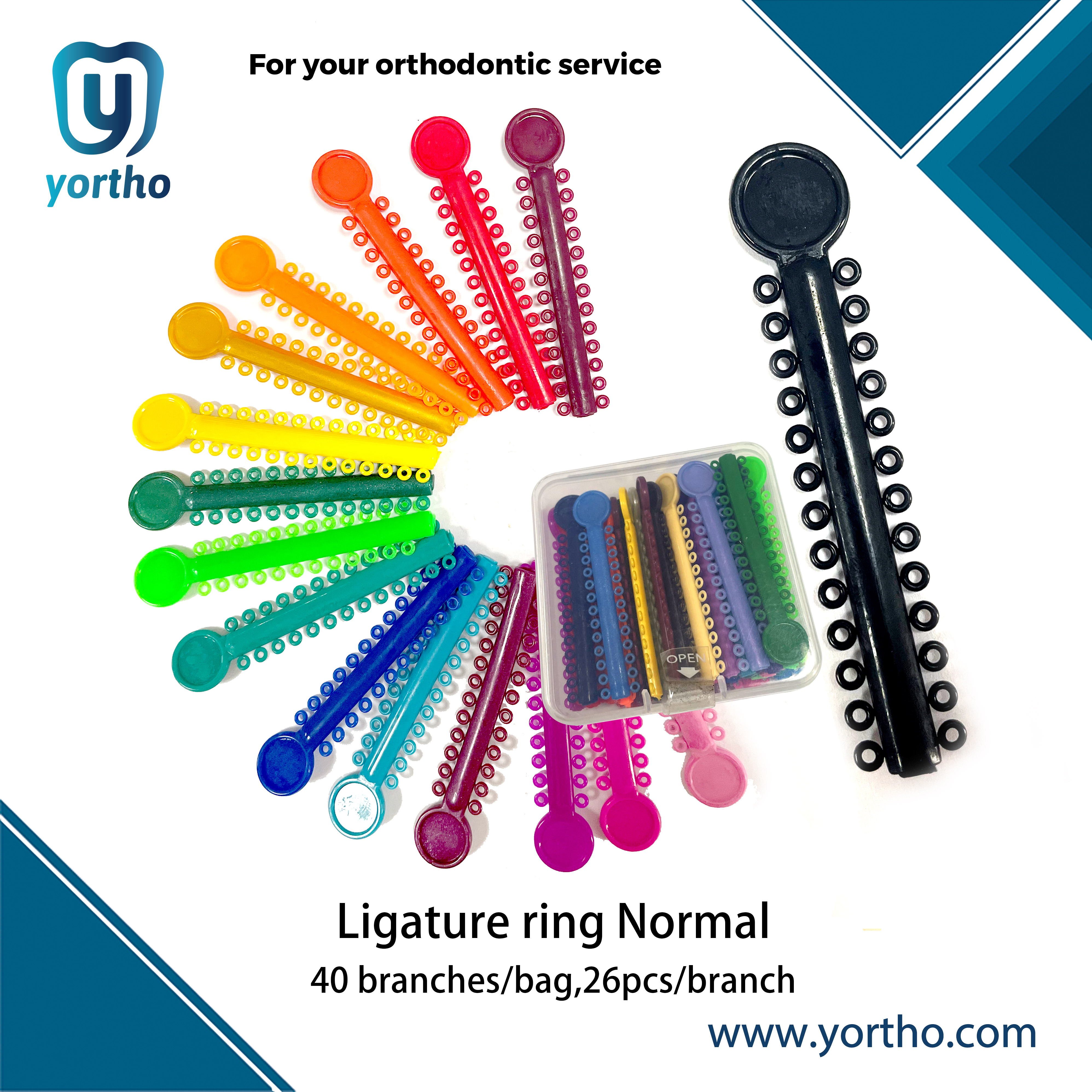
An elastic ligature is an individual elastomeric ring used to secure an arch wire in a bracket slot. It is a single-use consumable in the application context described in the supplied material. Its basic role is to hold the wire in place while allowing the clinician to change or replace the tie during treatment.
The Yortho Y-S80201 is listed as a ligature ring in normal and clear versions, made from high-elasticity polymers. The supplied description notes low force decay and elastic memory, a smooth surface intended to reduce irritation to soft oral tissues, colour options with good colour fastness, high tear resistance, uniform loop dimension and a low breakage rate. These are product claims from the manufacturer’s material, not independent clinical findings.
Elastic ligatures are often bought in larger volumes than lingual buttons or crimpable hooks because they are replaced more frequently. That makes pack format and colour selection part of the buying decision. A clinic may need clear ligatures for aesthetic cases and coloured ligatures for routine use, while a distributor may need a compact assortment that matches local demand. The key is to keep the product identity clear: a ligature ring is not a power chain, and a power chain should not be ordered from a line that only describes individual ties.
How these four differ from arch wires, brackets and instruments
The simplest way to separate the categories is to ask what the item is attached to. A bracket is bonded to a tooth and provides a slot for the arch wire. An arch wire is the main wire that runs through the bracket slots and carries the planned force. An orthodontic instrument is a reusable tool used to place, adjust or remove the appliance. An auxiliary is a supporting component that changes how the main appliance works.
Lingual buttons and crimpable hooks are attachment auxiliaries. Power chains and elastic ligatures are elastomeric auxiliaries. The first pair creates or adds a point of connection; the second pair contributes to ligation or force application. Neither pair is a substitute for the bracket system or the arch wire.
| Item | Basic purpose | How it connects | What it is not | Yortho reference |
|---|---|---|---|---|
| Lingual button | Provides a traction attachment point on the lingual surface | Bonded to a tooth | Not a bracket and not part of the main arch wire slot | Y-F307 bondable lingual eyelet |
| Crimpable hook | Adds a hook position on the arch wire | Crimped onto an arch wire | Not a bonded bracket and not a lingual button | Y-F201 crimpable hook |
| Power chain | Provides a continuous elastomeric chain for space closure | Placed across selected attachments | Not an individual ligature and not an arch wire | Y-S80101 power chain |
| Elastic ligature | Secures the arch wire in the bracket slot | Applied as an individual elastomeric ring | Not a continuous power chain | Y-S80201 ligature ring |
| Bracket | Main bonded attachment with a wire slot | Bonded to a tooth | Not an auxiliary | Bracket range |
| Arch wire | Main force-generating wire | Engaged in bracket slots | Not an auxiliary | Arch wire range |
| Orthodontic instrument | Reusable tool for placement and adjustment | Hand-held during procedures | Not a consumable auxiliary | Pliers and hand instruments |
The table is a category map, not a treatment protocol. It shows why a purchase order should name the product family before it names the brand or the price. A buyer who orders a hook when the clinic needs a bonded button, or a power chain when the clinic needs individual ligatures, has a specification error rather than a supplier error.
Use cases: where these auxiliaries enter treatment mechanics
Lingual buttons are used when a treatment plan needs an attachment point on the lingual surface. The supplied product description refers to various orthodontic traction cases, which is the appropriate level of detail for a category guide. The buyer’s task is to confirm the base, ring and material, not to infer a universal clinical indication from a catalogue image.
Crimpable hooks are used when a hook position is needed on the arch wire. Because the hook is crimped to the wire, the wire size and the hook specification have to be checked together. A 0.022-inch hook specification should be read as a product dimension, not as proof that the hook fits every wire or every bracket system without verification.
Power chains are used when a continuous elastomeric chain is chosen for space closure. The basic distinction from an elastic ligature is the form of the product: a chain is continuous, while a ligature is an individual ring. The buying team should confirm the model, the pack and the current specification because the supplied reference material for this article does not provide dimensional or force data for Y-S80101.
Elastic ligatures are used for routine arch wire ligation. They are the most obvious consumable in this group and the item most likely to be ordered in colour assortments. The supplied Y-S80201 description includes normal and clear versions, colour options and a smooth surface. Those features help a clinic or distributor plan a stock range, but they should still be matched to the bracket system, the case mix and the local documentation requirements.
Buyer checklist: what to verify before ordering
1. Confirm the product family. Decide whether the item is a bonded attachment, a wire-mounted hook, a continuous chain or an individual ligature. The four products in this guide are not substitutes for one another.
2. Confirm the material and surface. Lingual buttons and crimpable hooks in the supplied examples are stainless steel, while elastic ligatures are high-elasticity polymers. Surface finish, base design and material statement should be checked on the current specification sheet.
3. Confirm compatibility dimensions. The Y-F201 hook is listed with a 0.022-inch size and a 2.4 mm type. The Y-F307 button is listed with a round base. These values should be matched to the intended wire and bonding situation before purchase.
4. Confirm single-use or reusable status. Elastic ligatures are single-use consumables. Pliers are reusable instruments. The same logic should be applied to every item in the order so that sterilization and reprocessing instructions are not confused.
5. Request product-specific documentation. Yortho states ISO, CE under the EU MDR and FDA registration at company level. For a regulated purchase, ask for the documents that apply to the exact product and market. Do not assume that a bracket or wire standard automatically covers an auxiliary.
6. Check the pack and the sample. A sample request is the practical way to confirm the ring size, hook profile, base design or ligature colour before a larger order. Most Yortho samples are supplied free of charge except for higher-cost items such as pliers and self-ligating brackets; the buyer covers courier shipping.
7. Confirm lead time and destination. Yortho states that standard products are held in stock and can be packed and dispatched within 3 business days after payment confirmation. That statement applies to standard products, so the buyer should still confirm the exact item, quantity and destination before relying on it.
Biocompatibility and material restrictions can vary by market. The supplied application context notes that some markets require nickel-free or low-allergy material options and compliance documents. Buyers should confirm those requirements for the exact product and destination rather than assuming that one document covers every market.
FAQ
What certificates and documents should buyers check for orthodontic auxiliaries?
Yortho states that it holds ISO, CE under the EU MDR and FDA registration, and that its products are exported to the US, Europe and other regions. For a specific auxiliary, the buyer should request the product-level specification sheet, material statement, packaging information and any market-specific document required at destination. Company-level certification is a starting point, not a substitute for product-level review.
Who manufactures orthodontic auxiliaries such as lingual buttons, crimpable hooks, power chains and elastic ligatures?
Yortho is an orthodontic brand of YAM Global Limited with its own factory in Asia. Its product range includes orthodontic brackets, buccal tubes, molar bands, auxiliary attachments, elastic ligatures, arch wires and orthodontic pliers. The brand also states that OEM and ODM services are available. Buyers should confirm the manufacturing site and the exact product model before placing a bulk order.
Can I request samples of orthodontic auxiliaries before ordering?
Yes. Yortho’s stated sample policy is that most products can be supplied free of charge for a quality check, except for higher-cost items such as pliers and self-ligating brackets. The buyer covers courier shipping. A sample request should name the model, size, colour or pack format so that the sample matches the intended order.
What is the standard lead time for Yortho orthodontic auxiliaries?
For standard products held in stock, Yortho states that orders can be packed and dispatched within 3 business days after payment confirmation. The exact lead time still depends on the item, quantity and destination. To confirm availability and freight, share the product list, quantities and delivery address with the Yortho team.
Conclusion
Lingual buttons, crimpable hooks, power chains and elastic ligatures belong to the same broad auxiliary family, but they are different products with different attachment methods and procurement checks. Lingual buttons create a bonded traction point. Crimpable hooks add a hook position on the arch wire. Power chains provide a continuous elastomeric chain, while elastic ligatures secure the arch wire as individual rings. None of them replaces the bracket system, the arch wire or the instruments used to handle the appliance.
For buyers, the practical lesson is to specify the product family before comparing price. Confirm the model, material, dimensions, single-use status, documentation and sample. Yortho’s range covers these auxiliary categories alongside its bracket, tube, band, arch wire and instrument lines, and its published materials provide a starting point for a more precise RFQ.
For a current overview of the Yortho range, download the Yortho product brochure. For a sample or specification request, use the contact details on the official Yortho website and include the exact model, size and destination market.
Have Questions or Need More Details?
Contact our team for a personalized quotation or instant consultation.
Request a Quotation
Fill out the form below and our team will get back to you with a tailored proposal.
WhatsApp Direct Chat
Prefer to chat in real-time? Message us on WhatsApp for instant assistance & quick answers.
- Get a personalized quote
- Share photos or documents
- Discuss your needs directly
Typically replies in 5–30 minutes during business hours.