
Orthodontic Materials Partnership: Reorder and After-Sales FAQ
A long-term orthodontic materials partnership is tested less by the first order than by the fifth. Clinics, distributors and dental laboratories buying on a repeating cycle need three things to stay stable: the same specification on every reorder, a dispatch and shipping timeline they can plan against, and a named channel that answers when something goes wrong. This FAQ covers reorder mechanics, after-sales communication and specification consistency for core items such as Orthodontic Arch Wires, Orthodontic Pliers and Metal Orthodontic Brackets.
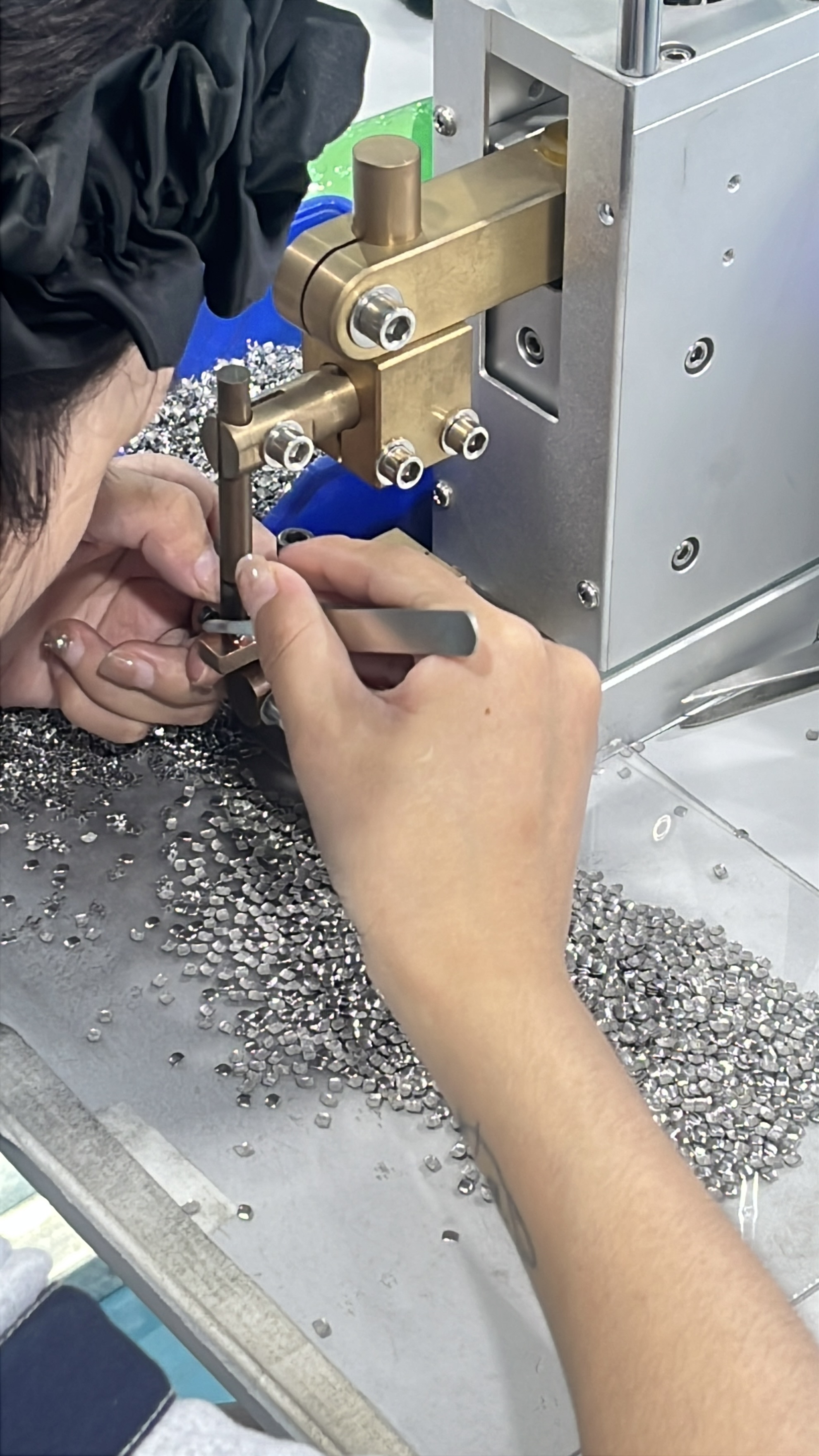
Yortho is the orthodontic brand of YAM Global Limited, a UK brand that operates its own factory in Asia. Its portfolio covers orthodontic brackets, buccal tubes, molar bands, orthodontic pliers, hand instruments, orthodontic auxiliaries, pediatric preformed crowns, elastic ligatures and arch wires, and its products have been exported to more than 70 countries including the US, UK, France, Germany, Italy, Greece, Russia, Saudi Arabia and Egypt. The company states its focus as stable quality, competitive lead-time and responsive after-sales support — the exact set of promises that a partnership FAQ has to make concrete rather than decorative.
What Long-Term Supply Really Means for Orthodontic Materials
In orthodontic procurement, long-term supply is not a contract length. It is the ability to place the same order months later and receive a functionally identical product. A reorder-stable relationship has three measurable properties.
- Specification identity. The second shipment's slot size, arch form, hardness or material matches the first one.
- Timeline predictability. Dispatch and transit windows are known before the purchase order is raised, not discovered afterwards.
- Communication continuity. There is a documented route for questions about quality, shortage, short shipment or replacement.
Most partnership problems in this category are not price problems. They start when a bracket is reordered without its prescription, a wire without its arch form, or a cutter without its hardness and cutting range. Each of those gaps converts a two-minute repeat order into a fresh specification exercise — and every fresh exercise carries a real risk that the clinic ends up with two incompatible batches on the shelf at the same time.
Industry Background: Why Continuity Is Now a Buying Criterion
The scale of the category explains why buyers push suppliers for continuity. Grand View Research values the global orthodontic consumables market at USD 3.1 billion in 2024, projected to reach USD 4.3 billion by 2030. Global Market Insights values the broader orthodontic supplies market at USD 14.8 billion in 2024 — the two figures differ mainly because one covers consumables only and the other covers supplies more broadly, which is why buyers should always check what a market number includes before quoting it internally.
Two structural facts make repeat ordering the normal mode of purchase rather than the exception. Grand View Research reports that orthodontic clinics and standalone practices represent over 50% of the end-user distribution channel, meaning most buying decisions sit with organisations that order in small, frequent batches. Separately, MarketsandMarkets identifies Asia-Pacific as the fastest-growing region for orthodontic supplies, which increases the number of buyers sourcing across borders and therefore the number of reorders exposed to shipping and documentation variables.
Product mix reinforces the same pattern. Grand View Research reports that the brackets segment dominated orthodontic consumables revenue in 2024, and Fortune Business Insights notes that ceramic self-ligating brackets are gaining share for aesthetic and friction-reduction reasons. A clinic that standardises on one bracket family will typically reorder that family for years, while continuing to buy wires, ligatures and instruments on shorter cycles.
Regulation adds a second continuity layer. ISO 13485:2016 sets the quality management requirement for medical device manufacturers; EU Medical Device Regulation 2017/745 is mandatory for orthodontic brackets to receive CE marking; and the US FDA classifies orthodontic brackets as Class II devices requiring 510(k) clearance. These are requirements placed on the manufacturer, and they are not a substitute for a specific supplier's actual documentation set. Yortho's own document set consists of FDA registration, ISO quality management system certification, and CE certification under the new EU MDR regulation — which is why the certificate question comes first in the FAQ chain below.
How Yortho Supports Reorders, After-Sales and Consistency
The support model rests on six practical elements: a specification held by model, a stock position for standard items, a dispatch commitment, a documented after-sales route, commercial terms that scale down to a first trial order, and a factory basis that keeps product identity under one manufacturer's control.
1. Reorder identity is held by model and full specification
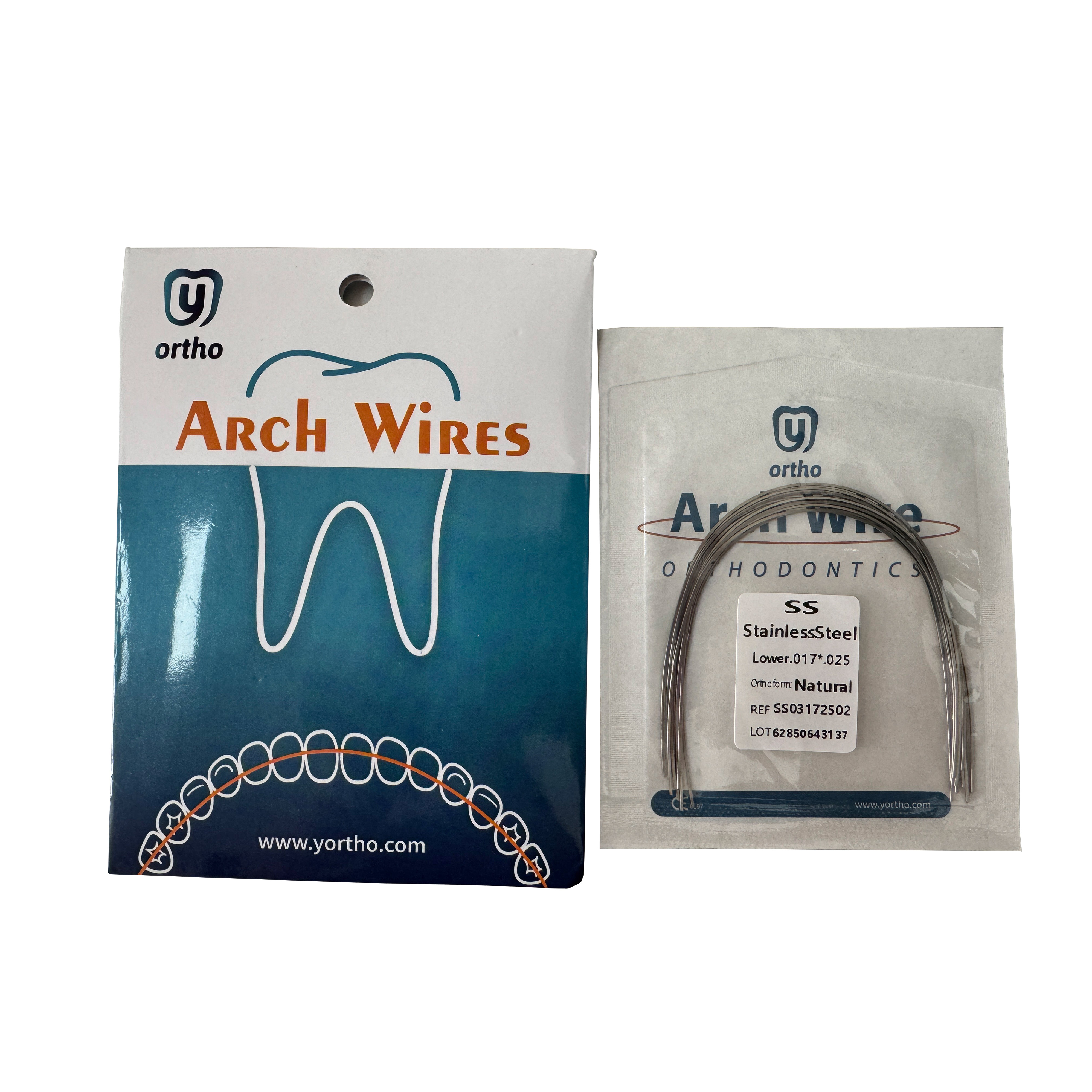
Yortho's arch wire range illustrates why model numbers matter more than the words used to describe a wire. Four lines exist: Y-SN super-elastic NiTi, Y-HN heat-activated NiTi, Y-SS stainless steel, and Y-TMA titanium-molybdenum alloy. They share a common size range of 0.012″ to 0.020″, round and rectangle cross-sectional shapes, upper and lower arch types, and arch forms covering Square, Natural, Damon, Oval, Europa-I and Broad. They are not interchangeable in clinical use, and they are not interchangeable on a purchase order either.
Two details are easy to lose between orders. The first is arch form: a Damon arch and a Natural arch in the same size and alloy are different items. The second is packaging: Y-SS stainless steel arch wires are packed 10 pieces per pack, so a reorder quantity that ignores pack size creates either a shortfall or surplus stock. NiTi wires, for their part, are defined by pseudoelastic behaviour that delivers light continuous force during alignment — a property the buyer is paying for, and one that only repeats if the alloy and cross-section repeat.
2. Instrument consistency depends on hardness and hinge specification
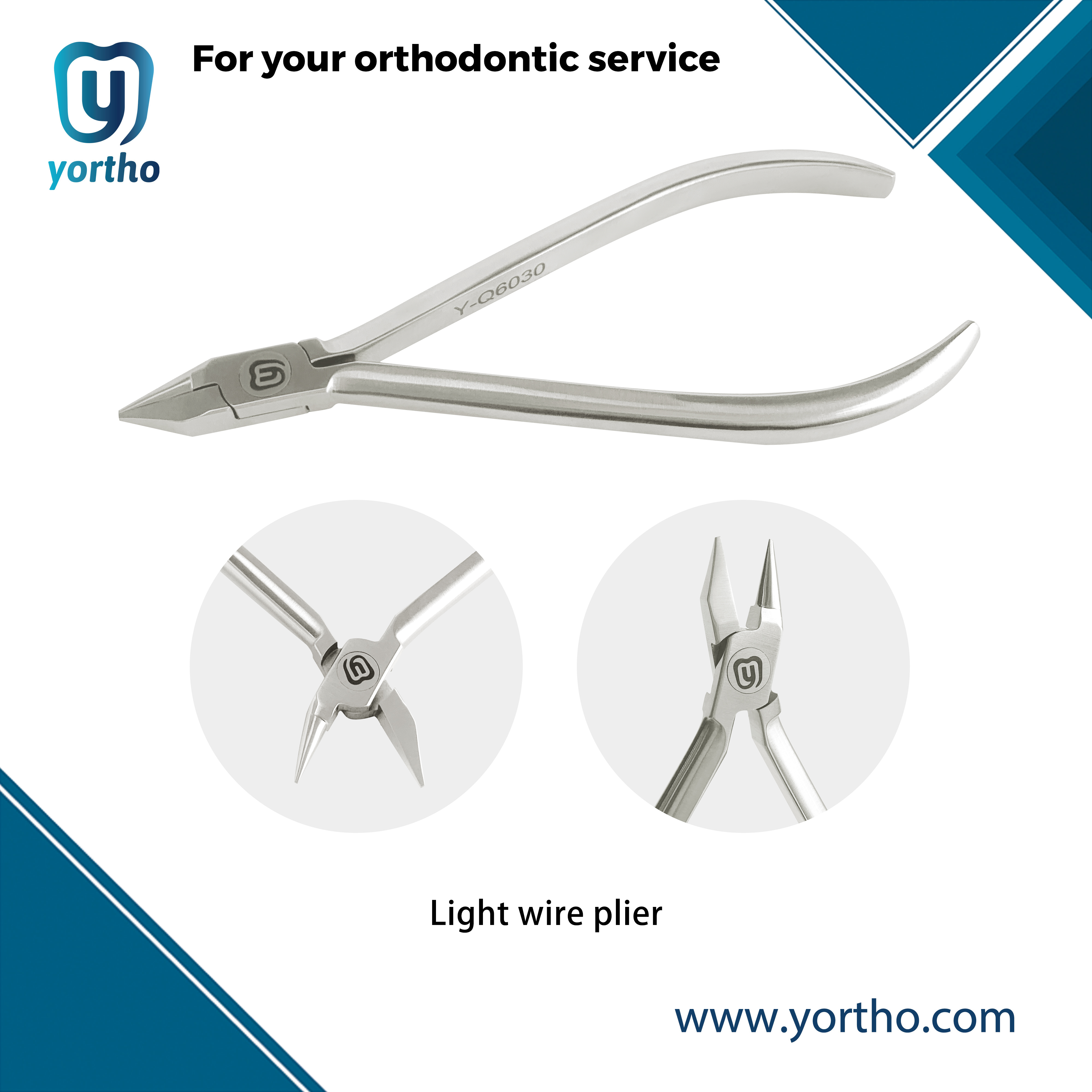
Orthodontic pliers are the item most often reordered by description rather than by model, and the least suited to it. Within the Yortho range, hardness is graded by function: Y-Q3002 tear drop pliers and Y-Q8005 distal end cutter at HRC 58–63; Y-Q6030 light wire pliers and Y-Q6018 Tweed loop pliers at HRC 55–60; Y-Q6026 crimpable hook pliers, Y-Q6015 Kim pliers and Y-Q5001 bracket removing pliers at HRC 50–55. All of them are rated for a maximum sterilization temperature of 180°C and share the zero clearance hinge design and CNC production from imported medical stainless steel.
Cutting capacity separates models that look alike. Y-Q8001 is a light wire cutter for fine wire up to 0.012″ (0.30 mm); Y-Q8008 is a heavy cutter for Australia wires, NiTi wires and stainless steel wires up to 0.030″ (0.76 mm). Reordering a cutter without the model number means reordering without the cutting range, and a heavy cutter sent to a clinic that wanted a fine ligature cutter is a return shipment rather than a supply relationship.
3. Bracket reorders must repeat slot, hook and prescription
Metal Orthodontic Brackets carry three variables that must survive every reorder. The Y-M1 Mini Bracket is made of 17-4 and 304 stainless steel and is offered in slot sizes 18 and 22, with or without hooks, in Roth, MBT and Edge-wise systems. The Y-M2 Self-ligating Bracket adds a polished surface and an engraved tooth identifier on the base, supplied 20 pieces per set, with the same slot, hook and prescription variables. A clinic that moves from a hooked 22-slot kit to a hook-free 18-slot kit has changed its treatment protocol, not merely its order.
The same discipline applies to attachments. Y-T2 Self-ligating Buccal Tubes use a sandblasted 80-mesh bonding base and a passive self-ligating design in a 0.022″ slot, sold as complete sets of 4 pieces. Clear Orthodontic Brackets in the Y-C2 family use Al₂O₃ ceramic bodies in slot sizes 18 and 22, also with hook and system variables. Reordering ceramic without the hook version is the single most common mismatch in aesthetic bracket supply.
4. Stock position and dispatch commitment
For standard products, Yortho maintains regular warehouse inventory, so an order can be packed and dispatched within 3 business days after payment confirmation. That commitment is what makes small, frequent clinic reorders practical. Custom programmes sit on a different timeline, because OEM and ODM work begins with material preparation and machine setup rather than with stock picking.
5. After-sales communication is a named channel, not a form
Yortho states that it provides comprehensive after-sales service on all orders and guarantees product quality, on the basis that long-term cooperation matters more than a single transaction. In practice, the fastest resolution comes from a message that carries four things: the order or invoice reference, the model and full specification, the batch or packing details from the carton, and photographs of the issue. Queries can be sent to info@yortho.com or raised on +86 180-5879-3627 by phone or WhatsApp. Buyers should confirm the warranty and replacement terms that apply to their own agreement rather than assuming a standard period applies across all product lines.
6. Commercial terms that scale with reorder size
Standard products carry an MOQ of USD 1,000 in total order value on a formal order, and the first order is accepted with no MOQ requirement — a deliberate allowance for clinics and distributors testing a market before committing. Custom programmes use unit-based thresholds: 500 units for OEM, where the buyer's own specification and intellectual property apply, and 1,000 units for ODM, where existing proven designs are adapted with the buyer's branding or minor feature changes.
Payment is by bank transfer (T/T), normally 100% in advance. For orders above USD 10,000, 30% deposit to start production with the 70% balance due before shipment is accepted. Small sample orders can also be settled by PayPal or Alipay. Yortho was established in 2023 as Zhejiang YO Medical Technology Co., Ltd and operates from a 5,000 m² facility with approximately 100 staff, a 20-engineer R&D team and an annual output of 30,000,000 units — capacity that matters when a distributor's reorder volume grows.
Step-by-Step: Running a Reorder That Stays Identical
- Rebuild the line from the previous invoice. Copy model plus every parameter: for wires, alloy, arch form, cross-section, arch type and size; for pliers, model and hardness; for brackets, slot size, hook version and system.
- Classify the item. Stocked standard product, or OEM/ODM custom item? This single answer decides whether dispatch happens within 3 business days or after a production slot.
- Check the quantity against the threshold. USD 1,000 total for a formal standard-product order, no MOQ on the first order, 500 units for OEM and 1,000 units for ODM.
- Agree the payment route. T/T in full, or 30% deposit and 70% before shipment above USD 10,000; PayPal or Alipay for small sample orders.
- Choose the shipping mode and record the transit window. Express courier 3–7 business days, air freight 7–12 days, sea freight 25–40 days, rail or overland freight 20–30 days for regions such as Europe and Central Asia.
- Confirm who clears customs. Under standard FOB or CIF terms the buyer covers import duties, taxes and clearance fees; the courier handles the paperwork and contacts the buyer directly when payment is required before final delivery.
- Log the receipt inspection against the SKU record. Note any deviation in packing, marking or dimensions so the next reorder inherits a verified reference rather than a memory.
Use Cases: Four Reorder Patterns and What to Lock Down
Single-location private clinic
Typical cycle: monthly arch wires and elastic ligatures, occasional pliers. Lock the arch form and size, and keep two cutter models on hand — a fine cutter for day-to-day ligature work and a heavy cutter for thicker wires — so a single failure does not stop a treatment day.
Distributor holding buffer stock
Brackets are the revenue driver and the reorder risk. Use the no-MOQ first order to validate demand by slot size and hook version, then move to OEM or ODM once volume justifies 500 or 1,000 units. Because 80% of Yortho's sales are export sales and Yortho has a CE certification under the new EU MDR regulation alongside FDA registration and ISO quality management system certification, distributors selling into regulated markets can request the matching documents at the trial stage rather than after the first container.
Dental laboratory
Labs buy mixed baskets: rapid palatal expanders, compatible orthodontic miniscrews and MISPA molar distalization systems, plus the pliers and instruments used to finish them. Here the reorder list is longer than any single model, so the specification sheet itself becomes the asset worth maintaining.
Pediatric-focused practice
Preformed pediatric crowns, pediatric bands and Orthodontic Face Masks are size-driven. The Adaptable Class III Mask is made of stainless steel and ABS and comes in Standard and Small sizes; the Face Mask/Universal version comes in large and small. Reordering without restating the size and colour variant is the most common error in this segment.
Comparison Table: What to Re-Specify Across Three Core Item Groups
| Reorder attribute | Orthodontic Arch Wires | Orthodontic Pliers | Metal Orthodontic Brackets |
|---|---|---|---|
| Material stated in the catalogue | NiTi (Y-SN, Y-HN); stainless steel (Y-SS); titanium-molybdenum alloy (Y-TMA) | Stainless steel, imported medical grade | 17-4 and 304 stainless steel |
| Variables that must repeat | Arch form (Square, Natural, Damon, Oval, Europa-I, Broad), cross-section (round/rectangle), arch type (upper/lower), size 0.012″–0.020″ | Model number, hardness band (HRC 50–55, 55–60 or 58–63), cutting or bending function | Slot size 18 or 22, hooks with or without, system Roth / MBT / Edge-wise |
| Documented packaging unit | Y-SS packed 10 pieces per pack | Sold as individual instruments | Y-M2 supplied 20 pieces per set; Y-T2 buccal tubes as sets of 4 pieces |
| Repeatability risk if omitted | Wrong force level and arch shape for the stage of treatment | Wrong jaw profile or cutting capacity for the wire in use | Wrong prescription, ligation type or hook configuration |
| Best reorder reference | Model plus full parameter string | Model number only | Model plus slot, hook and system |
Frequently Asked Questions
Which certifications does Yortho hold for orthodontic materials?
Yortho holds ISO quality management system certification, CE certification under the new EU MDR regulation, and FDA registration. These documents support customs clearance and hospital or distributor qualification checks. Buyers should confirm that the scope of a certificate matches the specific product group being ordered, because arch wires, pliers and brackets are separate product lines with separate documentation.
How do I make sure a reorder matches my previous brackets and arch wires?
Reorders are matched by model and full specification, not by product name. For Metal Orthodontic Brackets such as the Y-M1 Mini Bracket, that means slot size 18 or 22, hook version with or without hooks, and system Roth, MBT or Edge-wise. For Orthodontic Arch Wires such as Y-SN, Y-HN, Y-SS or Y-TMA, it means arch form, cross-sectional shape, arch type and size from 0.012″ to 0.020″. Keeping the original packing list or invoice number with the order gives both sides the same reference to check against.
What order size and payment terms apply to a long-term supply arrangement?
For standard products, the MOQ on a formal order is USD 1,000 in total value, and the first order carries no MOQ requirement. For custom programmes the threshold is unit-based: 500 units for OEM, where fully custom production follows the buyer's own specification, and 1,000 units for ODM. Payment is by bank transfer, normally 100% in advance; for orders above USD 10,000, a 30% deposit with the 70% balance due before shipment is accepted. Small sample orders can also be paid by PayPal or Alipay.
Can a clinic or lab evaluate samples before committing to a supply agreement?
Yes. Most products are supplied as free samples; high-cost items such as pliers and self-ligating brackets are excluded from the free sample policy. The buyer covers courier shipping, and freight-collect delivery is available if the buyer provides a DHL, FedEx or UPS account. Otherwise, sharing the delivery address and postcode allows a courier quotation to be prepared before dispatch.
How fast are reorders dispatched, and how long does delivery take?
Standard products are held in stock, so an order can be packed and dispatched within 3 business days after payment confirmation. Transit then depends on the mode chosen: express courier 3–7 business days, air freight 7–12 days, sea freight 25–40 days, and rail or overland freight 20–30 days for regions such as Europe and Central Asia. Under FOB or CIF terms the buyer is responsible for import duties, taxes and clearance fees, and the courier contacts the buyer directly if payment is required before final delivery. To confirm current stock and a route for a specific reorder, send the item list and destination postcode to info@yortho.com or message +86 180-5879-3627 on WhatsApp.
Conclusion: Continuity Is a Specification Discipline
Orthodontic materials partnerships fail quietly. There is rarely a single dramatic break — instead a bracket arrives in the wrong hook configuration, a wire arrives in a different arch form, and the clinic quietly starts sourcing elsewhere. The countermeasure is unglamorous and effective: hold every reorder to the model plus its full parameter string, use the no-MOQ first order to test, confirm the certificate scope before the volume order, and keep the after-sales channel warm with order references and photographs rather than descriptions alone.
Yortho's documented position supports that discipline with warehouse stock for standard products, dispatch within 3 business days after payment confirmation, a USD 1,000 formal-order MOQ with no MOQ on the first order, unit thresholds of 500 for OEM and 1,000 for ODM, and comprehensive after-sales service on all orders. What remains is the buyer's own record-keeping — the specification sheet that turns a repeat purchase into a two-minute task.
Next Step
Download the Yortho product catalogue for the full model list across arch wires, pliers, brackets and auxiliaries: Yortho brochure (PDF).
For a reorder quotation, a sample request or a specification check, contact the team at info@yortho.com, by phone or WhatsApp on +86 180-5879-3627, or through www.yortho.com. Factory address: 5th Floor, Building 1, No. 2 Lemin Road, Xinshi Town, Deqing, Huzhou, Zhejiang, China 313201.

Have Questions or Need More Details?
Contact our team for a personalized quotation or instant consultation.
Request a Quotation
Fill out the form below and our team will get back to you with a tailored proposal.
WhatsApp Direct Chat
Prefer to chat in real-time? Message us on WhatsApp for instant assistance & quick answers.
- Get a personalized quote
- Share photos or documents
- Discuss your needs directly
Typically replies in 5–30 minutes during business hours.