What Are Orthodontic Lingual Buttons? A Guide for Dental Professionals
An orthodontic lingual button is a small, bondable attachment fixed to the lingual, or tongue-facing, surface of a tooth so that an elastic, power chain, ligature or wire auxiliary has a reliable point to pull from. Clinicians specify one when the force has to come from behind the arch: derotating a crowded incisor, drawing a blocked-out or impacted tooth into line, correcting a crossbite, or holding a lingual arch in position.
This guide is written for dental professionals, practice owners and procurement teams who need to understand the component before they specify, order or stock it. It explains what lingual buttons do, how they differ from lingual eyelets, crimpable hooks and full lingual brackets, which variants cover which clinical situations, and what to verify on the manufacturing and compliance side when the decision moves from evaluation to purchase.
What Is a Lingual Button? A Working Definition
A lingual button is a low-profile metal or ceramic attachment with a rounded head or groove, bonded to enamel with the same composite adhesive system used for brackets. Its base is normally a mesh pad: the Y-F303 Bondable Lingual Button, for example, is a round stainless steel button with an 80# mesh base, which gives the adhesive a mechanical interlock to grip.
Because the attachment is bonded rather than welded or crimped, it can be positioned exactly where the force vector is needed, including on a partially erupted or rotated tooth that carries no bracket. Because it is small, the labial surface stays free for other mechanics.
Four terms are often used interchangeably and should not be:
- Lingual button - a bonded pad with a rounded head, used as an elastic or chain attachment point.
- Lingual eyelet - a bonded attachment with a closed ring, used where a ligature, thread or elastic must be tied or threaded through instead of hooked over. Yortho supplies the Y-F307 Bondable Lingual Eyelet with a round base in stainless steel.
- Lingual eyelet traction hook - a bonded attachment combining the eyelet with a traction hook, such as the Y-F308, for cases that need both threading and a defined hook point.
- Crimpable hook - not bonded at all. It is crimped onto an archwire; the Y-F102 crimpable hook, for instance, is sized for 0.022'' wire. It is an archwire auxiliary, not a tooth-borne attachment.
All bonded variants share the same design logic: a small footprint on the tooth, a defined point for force application, and a base geometry that survives repeated loading between appointments.
The Problem: Why Lingual Anchorage Cannot Be Improvised
Three practical problems push a clinician towards a lingual button.
- There is no labial attachment point. When a tooth is partially erupted, impacted, or treated as a segment, there may be no bracket to hook an elastic onto. A bonded lingual button creates that point without adding a full appliance.
- The force has to run from the lingual side. Derotation, uprighting and crossbite elastics are frequently easier to direct from behind the arch, where the attachment can be placed over a chosen part of the crown to control the moment.
- The accessory must survive a demanding environment. The tongue moves across the lingual surface constantly, hygiene is harder to maintain, and moisture control during bonding is more demanding than on the labial side. A button that debonds mid-treatment costs chair time and interrupts the force sequence.
The result is a small line item with an outsized effect. The wrong base, material or geometry does not show up as a specification error; it shows up as a re-bond appointment, a stretched treatment timeline, or a traction sequence that has to be restarted.
Decision rule: choose the attachment from the force vector first, then the base and material second. If a ligature must be tied, the part is an eyelet. If an elastic is hooked, a round button will usually do. If both are needed, the eyelet traction hook covers both.
Industry Background: Where Lingual Attachments Sit in the Market
The commercial context explains why component-level decisions now attract more scrutiny. The global orthodontic supplies market was valued at USD 14.8 billion in 2024 (Global Market Insights). The narrower orthodontic consumables segment, the category that includes brackets, bands, wires and auxiliaries, was valued at USD 3.1 billion in 2024 and is projected to reach USD 4.3 billion by 2030 (Grand View Research). Estimates for orthodontics as a whole vary with scope, from USD 7.65 billion in 2024 to a projected USD 38.21 billion by 2034 (Polaris Market Research / Therapeutic Area Insight).
Demand is not evenly spread. North America held roughly 38.4% of the orthodontic market in 2025 (Straits Research), and orthodontic clinics and standalone practices account for more than half of the end-user distribution channel (Grand View Research). Malocclusion affects between 39% and 93% of adolescents depending on the population studied (J Dent & Oral Disord). Fixed labial appliances still dominate the category: buccal braces are expected to hold about 89.55% of market share by 2026 (Fortune Business Insights).
Lingual attachments sit outside that mainstream. They are specialised auxiliaries that solve what a labial appliance cannot, which is also why lingual mechanics carry a price premium: full lingual systems are reported at USD 8,000 to USD 13,000 in the U.S. market, against USD 3,000 to USD 7,000 for non-ligating metal braces (Fortune Business Insights).
Two material facts shape selection. Stainless steel remains the most widely used material for orthodontic arch wires and brackets (Grand View Research), and most bonded lingual buttons are supplied in stainless steel with ceramic options for aesthetic or allergy-sensitive cases. That matters because nickel and chromium are the primary allergens of concern in metal orthodontic components (Fortune Business Insights), so material disclosure belongs in the purchasing conversation, not only the clinical one.
On the supply side, China's dental instrument exports are concentrated in provinces such as Guangdong, Jiangsu and Zhejiang (customs data analysis). Yortho's manufacturing base sits in Zhejiang, in Huzhou's Deqing county.
Lingual Button and Lingual Auxiliary Variants from Yortho
Yortho is a UK brand belonging to YAM Global Limited that operates its own orthodontic manufacturing facility in Asia and exports to more than 70 countries, including the United States, the United Kingdom, France, Germany, Italy, Greece, Russia, Saudi Arabia and Egypt. The portfolio covers brackets, buccal tubes, molar bands, pliers, hand instruments, auxiliaries, pediatric preformed crowns, elastic ligatures and arch wires, with OEM and ODM services available.
Within that portfolio, the lingual group consists of five bonded attachments and two related lingual auxiliaries:
- Y-F303 - Bondable Lingual Button. Round head, 80# mesh base, stainless steel. The general-purpose button for elastic and chain anchorage.
- Y-F305C - Ceramic Bondable Lingual Button. Round base, ceramic. Specified where translucency or reduced metal exposure is the priority.
- Y-F307 - Bondable Lingual Eyelet. Round base, stainless steel. The closed ring lets a ligature or thread be tied through the attachment.
- Y-F308 - Bondable Lingual Eyelet Traction Hook. Round base, stainless steel. Combines eyelet geometry with a traction hook for cases that need both.
- Y-F322 - Lingual Button. Round base with hole, stainless steel. The perforated-base variant.
- Y-F314 - Lingual Chain. Sliver type, stainless steel. Connects lingual attachments across a segment.
- Y-F321 - Power Arm. Round shape, stainless steel. A lingual-side lever arm for delivering a controlled force vector.
Handling matters as much as the attachment itself on the lingual side, where direct vision is limited. The Y-X201 Lingual Brackets Tweezers has a curved tip with a clamping range suited to lingual attachments and is autoclavable up to 134 degrees C. Its function is simple: place and position a bonded attachment precisely on a surface the clinician cannot see straight on.
The surrounding equipment is standard fixed-appliance stock. Archwires include the Y-SS stainless steel range, the Y-SN super-elastic NiTi range and the Y-HN heat-activated NiTi range, supplied in 0.012 inch to 0.020 inch round and rectangular cross-sections across square, natural, Damon, oval, Europa-I and broad arch forms. Buccal tubes such as the Y-T1 and the self-ligating Y-T2, molar bands such as the Y-H6002, elastic ligatures (Y-S80201) and power chains (Y-S80101) complete the mechanics that a lingual button works against.
Step-by-Step: Selecting, Bonding and Maintaining a Lingual Button
Step 1 - Define the movement and the force vector
Write down the target movement and the direction the force must travel before opening any catalogue. Derotation, traction of an unerupted tooth, crossbite correction and segment anchorage each imply a different attachment position on the crown, and that position decides the part.
Step 2 - Choose the attachment geometry
Match the geometry to how the auxiliary will be attached:
- Plain round button (Y-F303) - elastic or power chain hooked over the head.
- Eyelet (Y-F307) - ligature, thread or elastic tied or threaded through the ring.
- Eyelet traction hook (Y-F308) - threading plus a defined hook point.
- Perforated base button (Y-F322) - round base with hole for alternative ligation options.
- Ceramic button (Y-F305C) - aesthetic or metal-sensitivity cases.
Step 3 - Confirm base, material and biocompatibility
The 80# mesh base on the Y-F303 is the mechanical retention surface for the adhesive. Material should be stated explicitly on the order: stainless steel for the standard button and eyelet range, ceramic for the aesthetic variant. For patients with known nickel or chromium sensitivity, that is the point at which the ceramic option is specified instead of the metal one.
Step 4 - Isolate and bond according to the adhesive protocol
Lingual bonding demands better isolation than labial bonding. Etching, priming, placement and curing follow the adhesive manufacturer's instructions without modification; the accessory choice should not change the bonding sequence. Use a lingual tweezer such as the Y-X201 to seat and reposition the attachment rather than handling it directly.
Step 5 - Load the auxiliary and verify the vector
Fit the elastic, chain or ligature and check that the force direction matches the original plan and that no elastic is impinging on the gingiva. Record the attachment type, its position and the activation date so the next appointment reproduces the same mechanics rather than guessing.
Step 6 - Plan removal and finishing from day one
Removal follows the same logic as debonding a bracket: controlled detachment with the correct instrument, then composite clean-up and polishing so the enamel is left as undisturbed as possible. Yortho supplies bracket-removing pliers (Y-Q5001, hardness HRC 50-55, autoclavable up to 180 degrees C) for this stage, alongside a wider plier range covering light wire cutting, heavy cutting, distal end cutting and loop forming.
Clinical Use Cases for Orthodontic Lingual Buttons
Derotating a rotated tooth
A rotated incisor or premolar often needs a couple applied around the long axis. Where the labial bracket cannot deliver that moment, a bonded lingual button provides a second point, and an elastic or ligature running between the two produces the rotational component.
Traction of an impacted or blocked-out tooth
After surgical exposure, an unerupted canine or premolar usually needs to be drawn towards the arch. A bonded button or eyelet on the exposed surface gives the traction elastic a fixed anchor, while the opposing end is attached to the archwire or a labial attachment.
Crossbite correction with elastics
Inter-arch elastics that cross the occlusion are easier to manage when one end sits on the lingual surface. A lingual button on the palatal aspect of an upper tooth, paired with a labial attachment on the lower arch, keeps the elastic path predictable and away from the occlusal contact zone.
Segmental anchorage and space closure
When mechanics are confined to a segment, bonded lingual attachments can hold a lingual chain (Y-F314) or a power arm (Y-F321) across the segment, allowing force to be applied without extending the appliance to the full arch.
Anchorage for a lingual arch or tooth-borne element
Lingual arches and other tooth-borne elements need a defined attachment point at the tooth surface. A button or eyelet provides it without adding labial hardware, which is useful where aesthetics or the existing appliance already limit access.
Aesthetic and metal-sensitive patients
Where visibility or material sensitivity is the deciding factor, a ceramic bondable lingual button (Y-F305C) keeps the attachment consistent with an aesthetic appliance plan and reduces exposed metal.
Lingual Button Variant Comparison
The table below lists the bonded and related lingual components in Yortho's catalogue. It is a specification reference, not a clinical recommendation; the choice still follows the force vector for the individual case.
| Model | Product | Type / Base | Material | Primary role |
|---|---|---|---|---|
| Y-F303 | Bondable Lingual Button | Round, 80# mesh base | Stainless steel | General elastic and chain anchorage |
| Y-F305C | Ceramic Bondable Lingual Button | Round base | Ceramic | Aesthetic or metal-sensitive cases |
| Y-F307 | Bondable Lingual Eyelet | Round base | Stainless steel | Ligature or thread tied through the ring |
| Y-F308 | Bondable Lingual Eyelet Traction Hook | Round base | Stainless steel | Threading plus traction hook |
| Y-F322 | Lingual Button | Round base with hole | Stainless steel | Alternative bonded lingual attachment |
| Y-F314 | Lingual Chain | Sliver type | Stainless steel | Connecting attachments across a segment |
| Y-F321 | Power Arm | Round shape | Stainless steel | Controlled lingual force vector |
Manufacturing, Compliance and Supply Facts for Evaluation-Stage Buyers
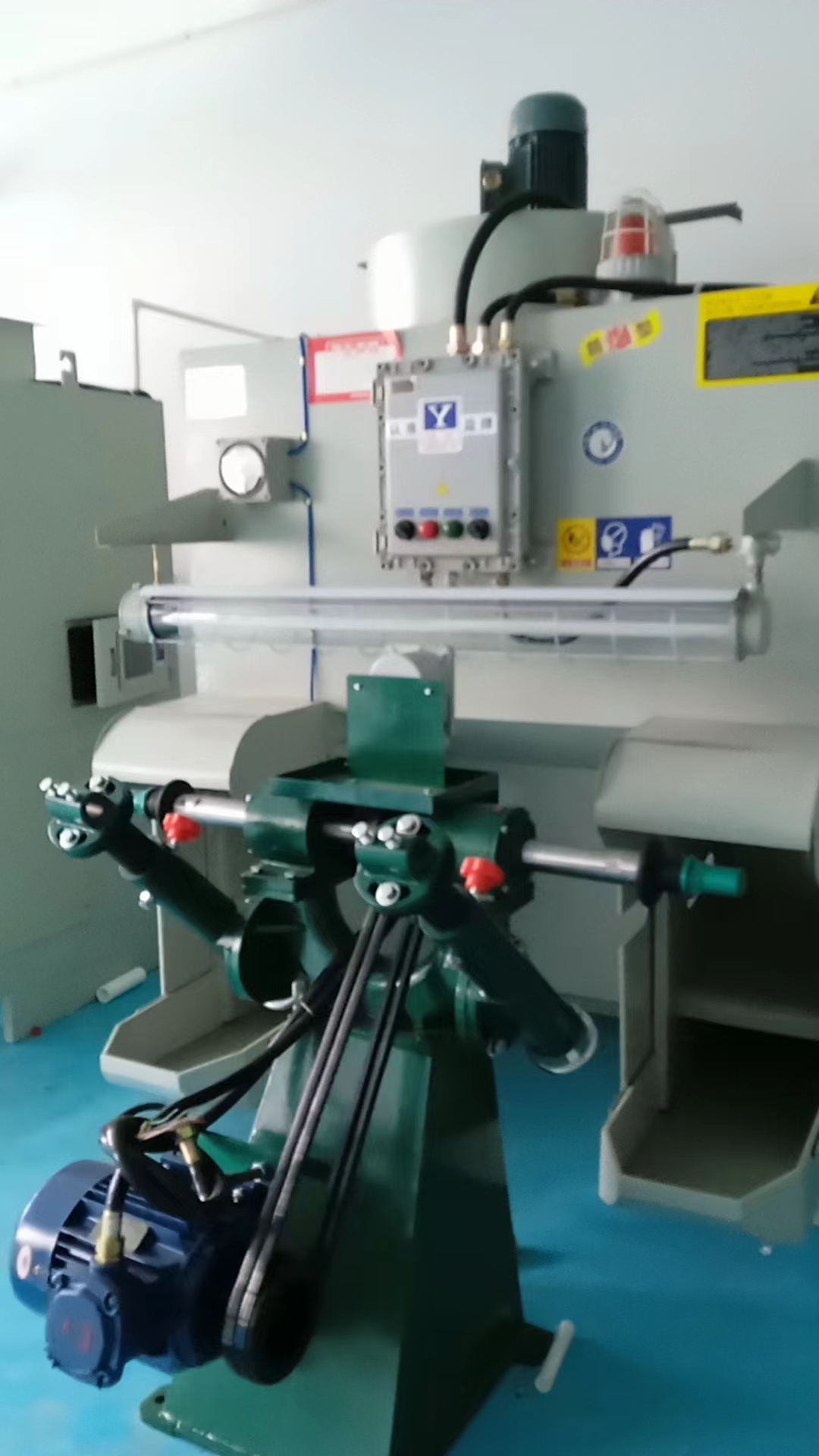
Once the clinical decision is settled, the checks move from geometry to operations. The facts below are Yortho's own and can be verified against documents before an order is placed.
| Check | Yortho fact |
|---|---|
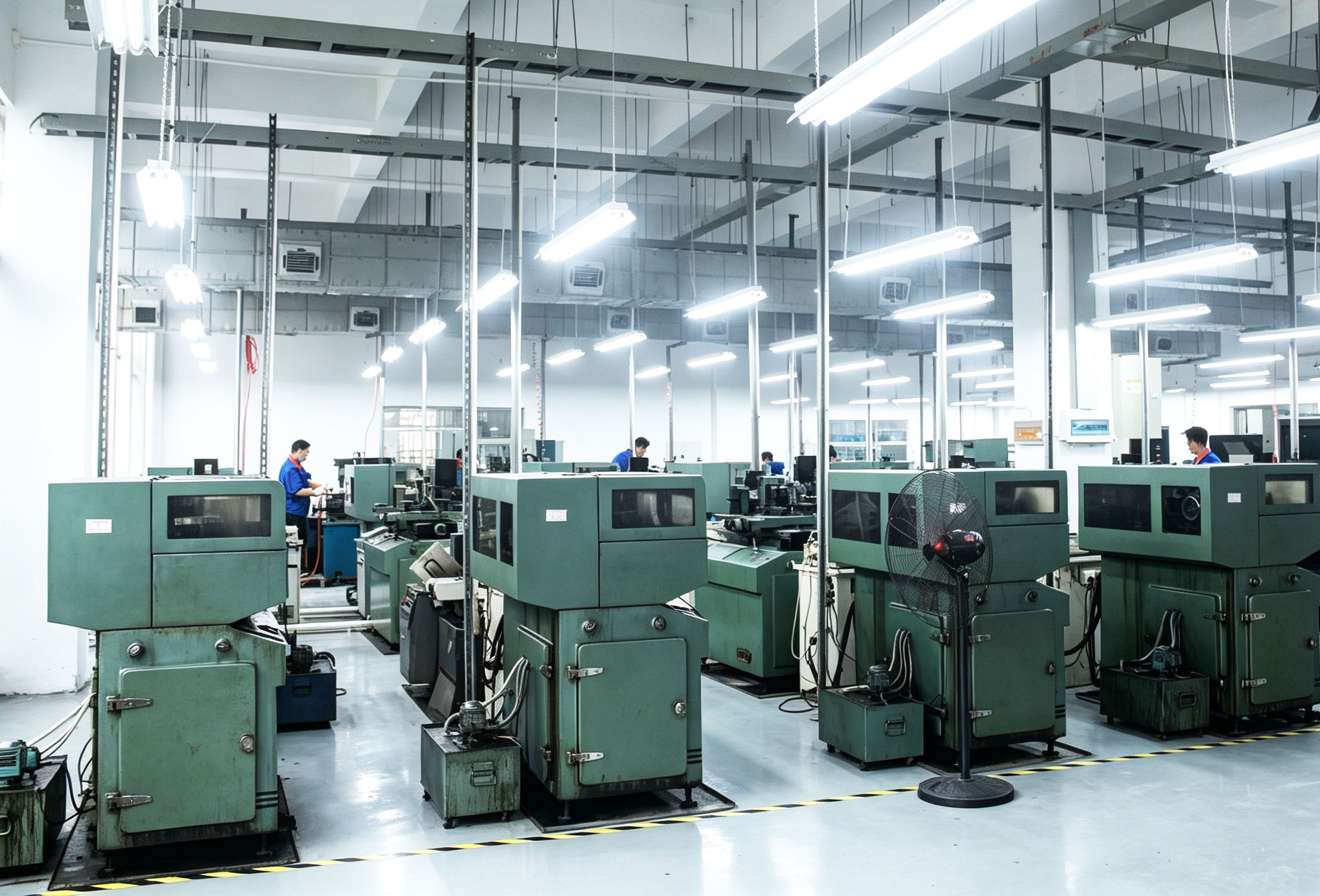
| Manufacturing entity and site | Zhejiang YO Medical Technology Co., Ltd, a 5,000 square metre factory in Huzhou, Zhejiang Province, China, with 100 employees and a 20-engineer R&D team |
| Output | 30,000,000 units per year; monthly capacity of 5,000 units |
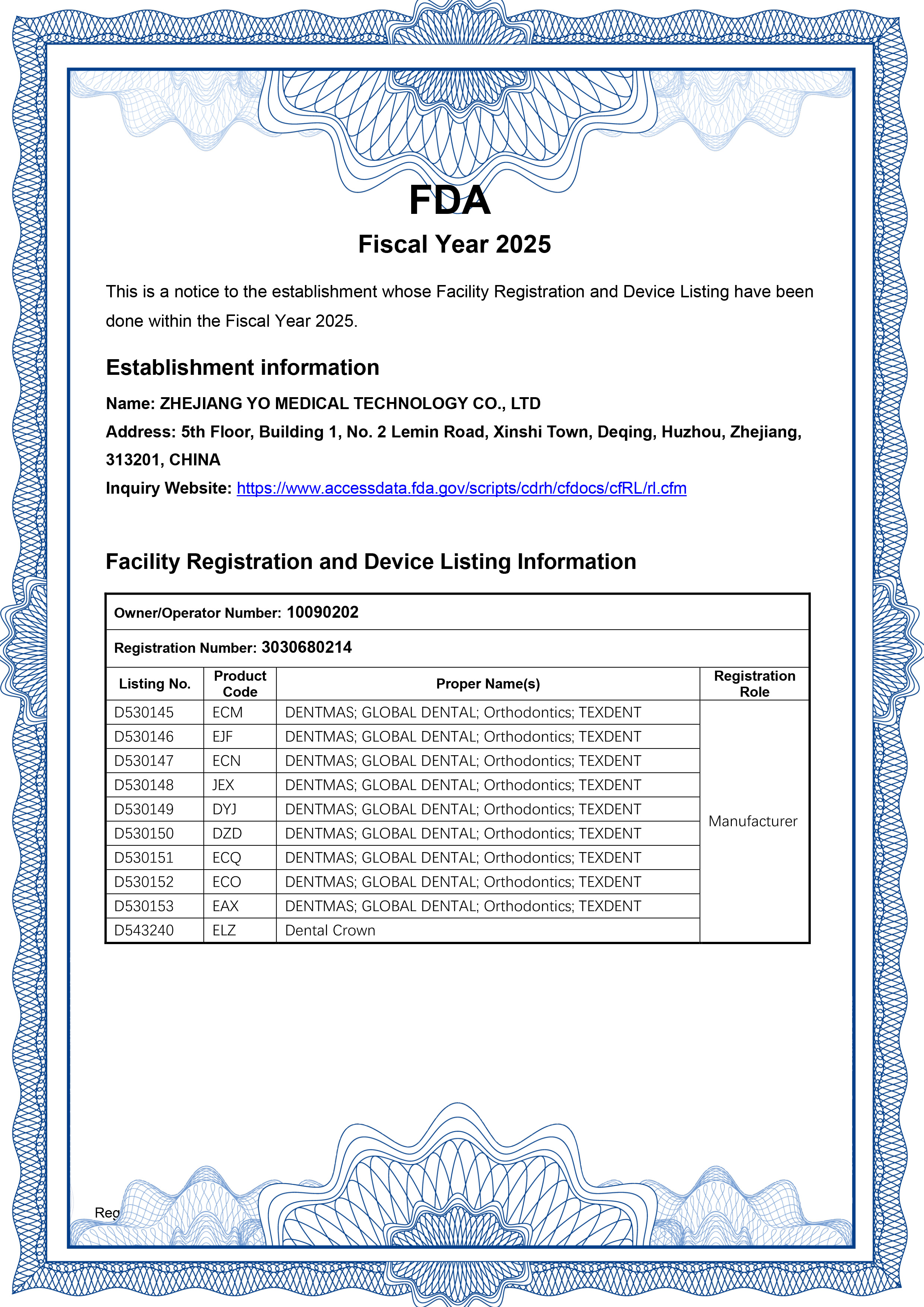
| Certifications | FDA registration No. 3030680214 (U.S. FDA / CDRH, 21 CFR Part 807), issued 27 February 2024 and valid through 31 December 2026; ISO quality management system certification; CE certification under the EU MDR; Certificate for Exportation of Medical Products No. Zhehang Food & Drug Admin Medical Device Export 20250496, issued by the Zhejiang Medical Products Administration for orthodontic pliers, valid 9 June 2025 to 8 June 2027 |
| OEM / ODM | Both available, with customization on packaging, logo, tag and product details |
| Quality control | 100% testing |
| Lead time | 3-7 days |
| Minimum order | From 100 units on custom runs; a USD 1,000 minimum order value applies to formal standard-product orders |
| Export markets | EU, Middle East, Asia, America, Africa and Australia; overall export ratio 80% |
| After-sales | Remote support |
Distributor evidence is available for practices and importers that want a track record rather than a specification sheet. Distributor relationships in markets including the United Kingdom, the United States, Italy, France, Germany, Egypt, Spain, Australia, Canada and Saudi Arabia have run between one and three years at order volumes around 5,000 units, with reported clinical feedback described as favourable and product performance consistent with local hospital requirements. A separate dental hospital programme in Indonesia covers 3,000 units over two years.
Frequently Asked Questions
What certifications should I verify before importing lingual buttons and orthodontic auxiliaries?
Start with the certificate numbers and their validity windows. Yortho holds FDA registration No. 3030680214 issued by the U.S. FDA / CDRH under 21 CFR Part 807, dated 27 February 2024 and valid through 31 December 2026, plus ISO quality management system certification and CE certification under the EU MDR. A Certificate for Exportation of Medical Products (CFS), No. Zhehang Food & Drug Admin Medical Device Export 20250496, was issued by the Zhejiang Medical Products Administration for orthodontic pliers and is valid from 9 June 2025 to 8 June 2027. For market access planning, note that medical device quality systems are assessed against ISO 13485:2016 internationally, and that CE marking for orthodontic devices sits under EU MDR 2017/745. Buyers should request the certificate PDFs relevant to their own market before placing a first order.
Can lingual buttons be produced as OEM or ODM with our own branding?
Yes. Yortho provides both OEM (Original Equipment Manufacturer) and ODM (Original Design Manufacturer) production services. Customization covers packaging, logo, tag and product details. The manufacturing base is Zhejiang YO Medical Technology Co., Ltd, a 5,000 square metre facility in Huzhou, Zhejiang Province with 100 employees and a 20-engineer R&D team, and the company exports to more than 70 countries with an 80% export ratio. Private-label programmes typically start from the existing lingual button and auxiliary range, then move to branded packaging and printed product details.
What is the minimum order quantity, and how much can be produced per month?
Custom production runs start from 100 units, and monthly capacity is 5,000 units, which lets a practice or distributor scale without committing to a large container load. A USD 1,000 minimum order value applies to formal standard-product orders. Annual output at the Zhejiang site is 30,000,000 units across the full orthodontic, pediatric and dental laboratory range.
Can we request samples before placing a bulk order?
Yes. Samples are available for quality checking. Most products are supplied free of charge, with the exception of higher-cost items such as pliers and self-ligating brackets; for those, the buyer covers the courier cost. If your practice or company holds a DHL, FedEx or UPS account, samples can be shipped freight collect. Otherwise, providing a delivery address and postcode allows Yortho to quote the courier cost before dispatch.
What is the production lead time, and how are orders shipped?
Standard lead time is 3-7 days. For standard catalogue products held in stock, orders can be packed and dispatched within three business days after payment confirmation. Shipping options are express courier (DHL, FedEx or UPS) at 3-7 business days, air freight at 7-12 days, sea freight at 25-40 days, and rail or overland freight at 20-30 days for regions such as Europe and Central Asia. Under standard FOB or CIF terms the buyer is responsible for import duties and taxes in the destination country, and the courier handles customs paperwork automatically. Sharing the destination country and postal code is the fastest way to get an exact routing recommendation and quotation.
Conclusion
Orthodontic lingual buttons are a small component with a specific job: provide a bonded anchor point on the tongue-facing surface when the labial arch cannot deliver the force a case needs. The clinical decision comes down to geometry, meaning button, eyelet or eyelet traction hook, followed by base, material and biocompatibility. The sourcing decision comes down to evidence: certificate numbers with valid dates, a stated monthly capacity, a defined customization scope, and a sample a clinician can evaluate on a real case before any volume commitment.
Yortho manufactures lingual buttons and the auxiliaries that work alongside them at its Zhejiang facility and supports both OEM and ODM programmes for practices, distributors and private-label brands. Start with one case, one sample and one specification document; the rest of the evaluation follows from there.
Next Step: Sample a Lingual Button, Then Scale
If you are evaluating lingual buttons for a practice, a clinic group or a private-label line, the practical first move is a sample request. Specify the model (Y-F303, Y-F305C, Y-F307, Y-F308 or Y-F322), the quantity and the destination market, and the compliance documents relevant to that market can be sent with the shipment.
Email: info@yortho.com | WhatsApp / Tel: +86 180-5879-3627 | Web: www.yortho.com
Contact: Anna Jin | 5th Floor, Building 1, No. 2 Lemin Road, Xinshi Town, Deqing, Huzhou, Zhejiang Province, China 313201
Have Questions or Need More Details?
Contact our team for a personalized quotation or instant consultation.
Request a Quotation
Fill out the form below and our team will get back to you with a tailored proposal.
WhatsApp Direct Chat
Prefer to chat in real-time? Message us on WhatsApp for instant assistance & quick answers.
- Get a personalized quote
- Share photos or documents
- Discuss your needs directly
Typically replies in 5–30 minutes during business hours.