Metal Orthodontic Brackets vs Ceramic Self-Ligating: A 2026 Cost-Performance Comparison for Buyers
Metal Orthodontic Brackets vs Ceramic Self-Ligating: A 2026 Cost-Performance Comparison for Buyers
For dental distributors, clinic procurement managers, and orthodontic practices comparing fixed appliance systems in 2026, the central decision is no longer just “metal vs ceramic.” It is about which bracket architecture — conventional metal, passive self-ligating metal, or ceramic self-ligating — delivers the best balance of clinical predictability, chair-side efficiency, and unit economics for a specific patient mix. This comparison focuses on measurable differences: material behavior, force control, workflow impact, and total procurement cost.
The Buying Problem: Cost-Performance, Not Just Price per Bracket
Orthodontic materials procurement decisions at the Decision stage usually stall on one question: “Are we paying a premium for features our clinicians will not use, or are we saving money on brackets that increase chair time and rework?” In both cases, the real metric is cost per completed case, not cost per bracket.
Traditional metal brackets remain the largest segment of the orthodontic consumables market — brackets dominated industry revenue in 2024, and stainless steel remains the most widely used bracket and archwire material globally. Yet self-ligating systems, especially ceramic self-ligating brackets, are gaining adoption because they reduce friction and improve aesthetics simultaneously. For a distributor or group practice, this creates a portfolio decision: which systems to stock, in which proportions, and from which manufacturer.
This article compares four representative Yortho product families — metal conventional brackets, metal self-ligating brackets, ceramic self-ligating brackets, and associated consumables — against typical alternatives on design, performance, maintenance, and cost, using first-party engineering comparisons and verified industry context.
What “Better” Means in Orthodontic Materials Comparison
In orthodontic supplies, “better” should be defined by criteria a buyer can verify and a clinician can feel. Across the comparisons that follow, five criteria are used consistently:
- Design & construction quality: surface finish, slot precision, internal cavity cleanliness, and whether the bracket reduces friction or creates it.
- Clinical performance: torque control, force stability, bonding precision, and treatment efficiency.
- Chair-side maintenance: ligation work, replacement intervals, rework frequency, and adjustment time.
- Patient experience: oral comfort, smoothness, and reduced soft-tissue irritation.
- Total cost: unit price difference plus the cost of rework, failed components, and longer treatment time.
This framework is used because a bracket that costs 30% less but increases bonding deviation or friction can easily become the more expensive option by the end of a 24-month treatment.
Category 1: Conventional Metal Orthodontic Brackets
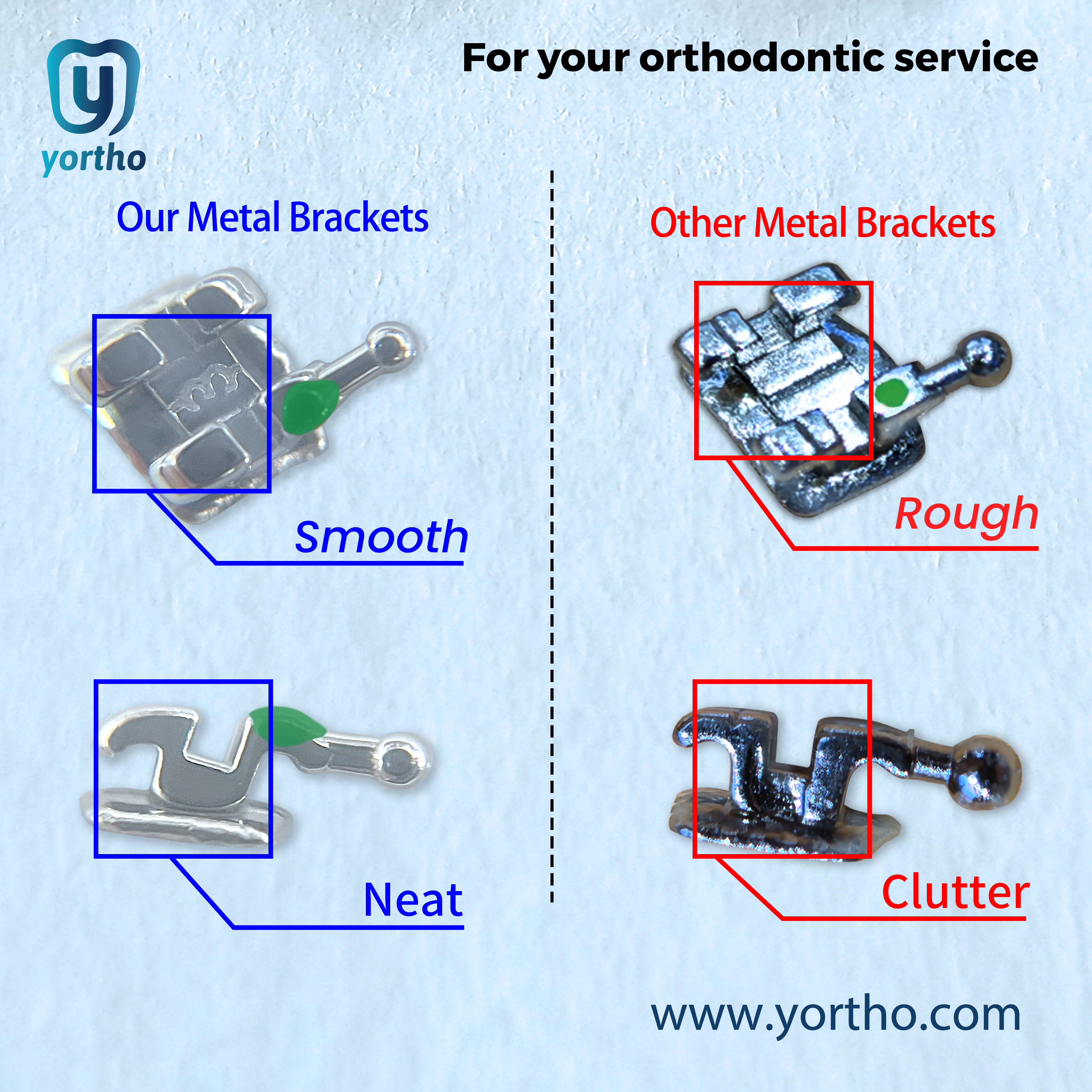
Yortho Y-M1 Mini Bracket vs Ordinary Metal Brackets
Conventional metal brackets are the workhorse of fixed orthodontics. The Yortho Y-M1 Mini Bracket is available in 0.018" and 0.022" slots, with or without hooks, in Roth, MBT, and Edge-wise systems, and is manufactured from 17-4 and 304 stainless steel.
The main performance gap versus ordinary metal brackets comes from two manufacturing variables: surface polishing and molding precision.
- Surface polishing: Yortho brackets feature a smooth, finely polished surface and slot design. Rough competitor surfaces increase friction between archwire and bracket, which slows tooth movement and creates unpredictable force delivery.
- Molding precision: Yortho uses a neat, precise integrated molding process with tidy structural details. Competing brackets often show cluttered structure and rough edges that irritate oral soft tissues and reduce wearing comfort.
The documented performance effect is a 30% reduction in diagnosis and treatment time and in the number of consultations, driven by lower friction and more stable orthodontic performance. The cost difference is equally significant: approximately 75% lower than comparable alternatives.
Maintenance is simplified by spacious ligation wings. Practitioners can add ligature rings to passive self-ligating brackets on demand, shifting from passive to active force mechanics without pre-mounted auxiliary hooks or extra clinical procedures.
When to Choose Conventional Metal Brackets
- High-volume practices treating a broad mix of malocclusion cases.
- Clinicians who prefer full control over ligation and force mechanics.
- Distributors building a cost-competitive private-label or value bracket line.
- Markets where proven stainless steel performance and lower unit price outweigh aesthetic preferences.
Category 2: Metal Self-Ligating Brackets
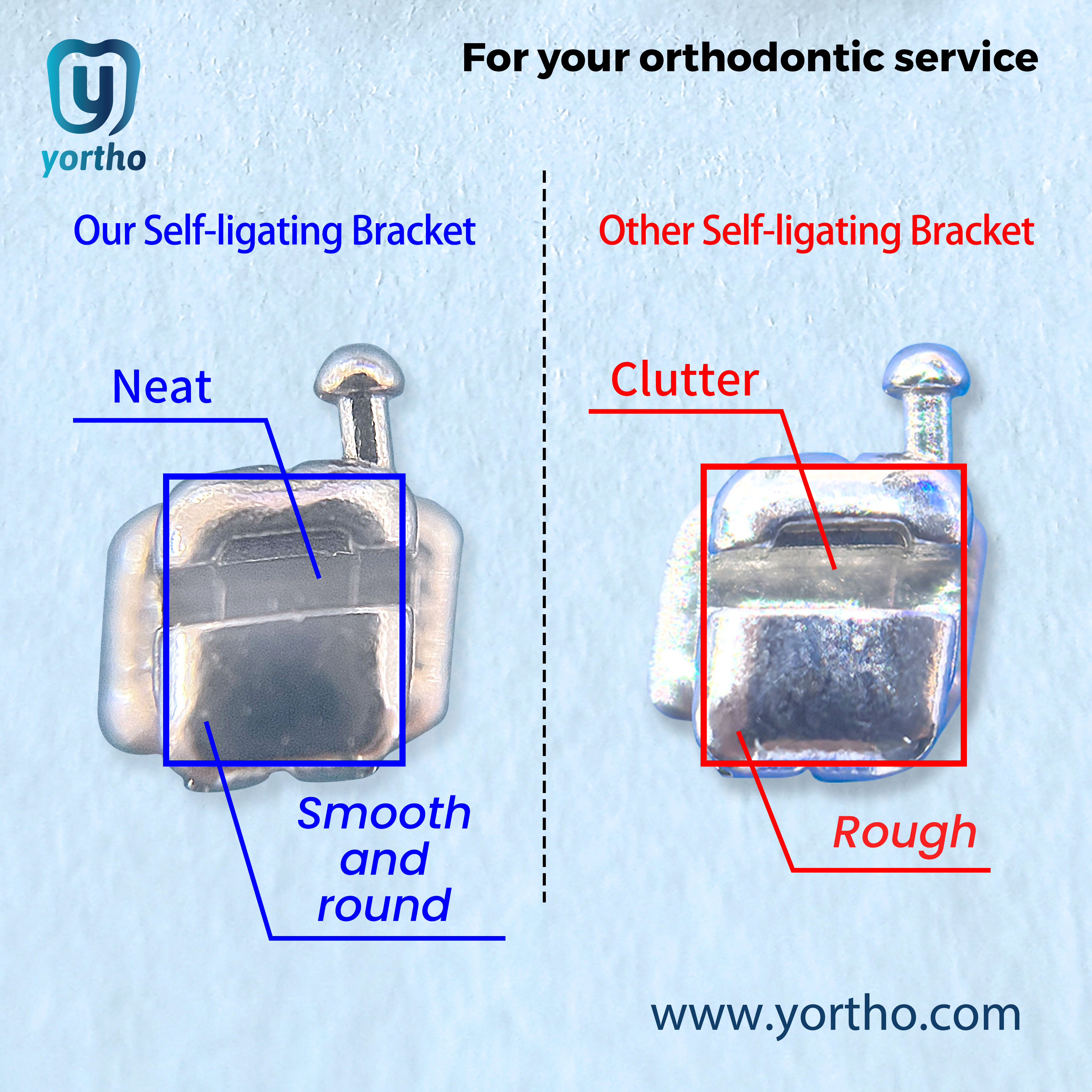
Yortho Y-M2 Self-Ligating Bracket vs Japanese Self-Ligating Brackets
Self-ligating brackets reduce or eliminate elastic ligatures, lowering friction and simplifying archwire changes. The Yortho Y-M2 Self-Ligating Bracket (also available in a Mini version) is offered in 0.018" and 0.022" slots, with or without hooks, in Roth, MBT, and Edge-wise systems, from 17-4 and 304 stainless steel.
Compared with Japanese self-ligating brackets, the Y-M2 shows advantages in two specific measurable areas:
- Cavity structure: The Y-M2 has neat inner cavities without casting burrs. Competitor products exhibit cluttered, flawed cavities that increase archwire friction and reduce sliding mechanics.
- Surface craft: Edges are smoothly rounded through fine polishing, while competitor edges remain rough and unpolished.
The clinical impact reported by Yortho customers is a 15–20% shorter treatment period. The cost difference is a 50% lower unit cost than comparable Japanese self-ligating systems.
From a maintenance standpoint, the cleaner internal cavity and polished edges mean less ligation resistance, fewer wire binding events, and less chair-side adjustment. This is the efficiency argument for self-ligation: less friction, faster alignment, and fewer emergencies.
When to Choose Metal Self-Ligating Brackets
- Practices that want the efficiency of self-ligation with the strength and proven track record of stainless steel.
- Clinicians treating patients who need lower force levels or longer intervals between adjustments.
- Distributors seeking a mid-price point between conventional metal and ceramic systems at 50% lower cost than established self-ligating imports.
Category 3: Ceramic Self-Ligating Brackets
Ceramic self-ligating brackets combine the aesthetic advantage of clear brackets with the friction-reduction benefits of self-ligation. The Yortho Y-C2 Mini Self-Ligating Ceramic Bracket is manufactured from Al₂O₃ (alumina ceramic) and is available in 0.018" and 0.022" slots, with or without hooks, in Roth, MBT, and Edge-wise systems.
In the broader orthodontic market, ceramic self-ligating brackets are gaining popularity for their aesthetic and friction-reduction benefits. Clinically, the combination matters: a ceramic bracket that still requires elastic ligatures loses some of the low-friction advantage; a self-ligating ceramic bracket preserves both aesthetics and sliding mechanics.
For procurement purposes, ceramic self-ligating brackets usually sit at a higher price point than metal, but the relevant comparison is against conventional ceramic brackets, not metal. The buyer question is: “If a patient requests a clear bracket, does the self-ligating version reduce chair time enough to justify the upgrade?” For practices that already use self-ligating workflows, the answer is often yes.
Yortho Y-C2 brackets are typically positioned as a mid-range ceramic self-ligating option, giving distributors a credible alternative in a segment that has been dominated by premium global brands.
When to Choose Ceramic Self-Ligating Brackets
- Aesthetic-conscious patients, especially adults and teens in the 13–19 segment that drives global orthodontic growth.
- Clinicians who want to avoid elastic ligature staining and discoloration.
- Practices adding a premium service tier without switching to full clear-aligner workflows.
Category 4: Supporting Consumables That Affect Case Cost
Brackets are not the only variable that determines materials cost. Archwires, power chains, buccal tubes, and pliers change the cost per completed case. The following comparisons use the same cost-performance logic.
Orthodontic Buccal Tubes
- Design: The mesial inlet adopts a chamfered triangular structure to facilitate archwire insertion; the occlusal edge of the mesh base has a buccal groove for positioning.
- Manufacturing: Precision casting with high-precision moulds for easy clinical operation and firm bonding.
- Performance: Extended tube boosts effective length by 20–25% for superior torque control. Occlusal indent plus tooth marking limits bonding deviation to ≤0.05 mm, sharply reducing misalignment risk.
- Insertion & comfort: The chamfered inlet cuts archwire insertion resistance by 30%; a 15% slimmer body reduces oral discomfort.
- Cost: Approximately 30% lower than other buccal tubes.
Faster, more accurate positioning means less bonding rework. Smooth wire insertion and durable structure reduce chair-side time, sudden failures, and patient follow-up workload.
Orthodontic Archwires: Heat-Activated NiTi
Heat-activated NiTi archwires are valued for delivering light continuous force. The Yortho heat-activated NiTi difference is “super-stable phase-transition with low force decay” plus “superior dimensional consistency with low residual deformation.”
- Af transition temperature tolerance of ±0.8°C, representing 60–68% less temperature deviation.
- Surface roughness Ra ≤0.08 μm, giving 55–62% lower friction coefficient.
- Permanent deformation ≤7%, 61–73% less residual distortion.
In practice, this means predictable tooth alignment, fewer wire replacements, and less chair-side adjustment. Replacement intervals extend to a 6–8 week cycle, reducing wire-change procedures by 30–40%. Overall cost is approximately 20% lower than comparable heat-activated alternatives.
Orthodontic Power Chains
Power chains are used for space closure and consolidation. Yortho Power Chains are made from premium non-latex medical-grade polyurethane, which eliminates latex-allergy risk for sensitive patients. The technical advantage is optimized force retention: a lower force-decay rate maintains stable light continuous force, while precision-molded loops ensure consistent loop-to-loop dimensions and repeatable force output.
- Permanent deformation reduced by 60–73%.
- Clinical simulated breakage reduced by 75–85%.
- Chair-side replacement frequency reduced by 30–50%.
- Cost approximately 10% lower than alternative power chains.
Fewer replacements and fewer emergency visits translate directly to lower total cost per case.
Orthodontic Pliers and Instruments
Instruments are a capital purchase, but low-quality pliers fail quickly and increase replacement cost. Yortho pliers are made from stainless steel with documented hardness ratings — for example HRC 58–63 for cutters, HRC 50–55 for Kim and bracket-removing pliers — and are autoclavable up to 180°C.
Compared with other brands, Yortho pliers deliver a 30% improvement in surface smoothness and material glossiness and a service life extended by 5–10 times. The minimum service life is stated as five years versus less than one year for some competing brands. Cost is at least 50% lower. For a clinic, this means the total cost of ownership is lower despite the emphasis on durability: fewer replacements, less rust, better grip, and consistent performance under repeated sterilization.
Pediatric Crowns: A Specialized Comparison
Pediatric preformed crowns are an adjunct used in space maintenance and pediatric restoration. Yortho Kids Crowns differ from other brands through two structural features:
- Elastic cervical margin design: The margin snaps tightly over the tooth contour, maximizing fit and reducing luting cement consumption. Marginal clearance is reduced to under 10 microns — a 45% reduction in luting cement use and 90% improvement in snap-fit adaptation.
- Ultra-bright mirror-polished surface: Surface roughness Ra is reduced from 0.2 to 0.05, leading to a 75% reduction in dental plaque adhesion. The smooth surface minimizes tongue friction and soft-tissue irritation.
Clinically, this reduces chair-side crimping time by 50% and postoperative gingival inflammation by 95%. Cost is approximately 10% lower than alternatives.
Orthodontic Expansion Screws
For palatal expansion, the Yortho I series Expansion Screw competes with a maxillary skeletal expander. The comparison is based on micro-precision:
- Optimized thread surface roughness lowered from Ra 0.4 to Ra 0.1, a 45% lower friction coefficient, with zero activation lock-ups.
- Ultra-tight micro-tolerance control: structural clearance below 3 μm, reducing mechanical play by 80% for superior linear expansion.
- Cost is 70–80% lower than a maxillary skeletal expander.
For clinicians, this means smoother activation, no sudden pressure surges, tilt-free expansion, and stable performance under heavy face-mask traction in Class III correction cases.
Head-to-Head Comparison Table
| Product Category | Key Yortho Design Difference | Measured Performance Gap | Cost Difference | Maintenance / Workflow Effect |
|---|---|---|---|---|
| Y-M1 Metal Brackets vs ordinary metal brackets | Superior surface polishing; precise integrated molding | 30% reduction in treatment time and consultations | 75% lower | Spacious ligation wings allow active/passive switching; no pre-mounted hooks needed |
| Y-M2 Self-Ligating vs Japanese self-ligating brackets | Neat inner cavities without casting burrs; rounded polished edges | 15–20% shorter treatment period based on customer feedback | 50% lower | Less wire friction, fewer adjustments, higher clinical efficiency |
| Y-C2 Ceramic Self-Ligating | Al₂O₃ ceramic body with self-ligating mechanism | Aesthetic bracket with reduced friction; designed for clear-bracket workflows | Mid-range ceramic self-ligating option | No elastic ligature staining; compatible with Roth/MBT/Edge-wise in 0.018/0.022 slot |
| Buccal Tubes vs other buccal tubes | Chamfered triangular mesial inlet; precision casting with high-precision moulds | 20–25% longer effective tube length; bonding deviation ≤0.05mm; 30% lower insertion resistance | 30% lower | Less bonding rework; smooth wire insertion; fewer sudden failures |
| Heat-Activated NiTi vs other heat-activated NiTi | Super-stable phase transition; low force decay; ultra-tight cross-section tolerance | Af tolerance ±0.8°C; surface Ra ≤0.08μm; permanent deformation ≤7% | 20% lower | 6–8 week replacement cycles; 30–40% fewer wire changes |
| Power Chains vs other power chains | Non-latex medical-grade polyurethane; precision-molded loops | 60–73% lower permanent deformation; 75–85% less simulated breakage | 10% lower | 30–50% less chair-side replacement frequency |
| Pliers vs other brands | Superior materials; meticulous manufacturing | 30% better surface smoothness; 5–10x longer service life | At least 50% lower | 5+ year useful life; fewer replacements; lower total cost of ownership |
| Kids Crowns vs other brands | Elastic cervical margin; mirror-polished surface | Marginal clearance <10μm; plaque adhesion reduced 75% | 10% lower | 50% less crimping time; 95% lower postoperative gingival inflammation |
| I-Series Expansion Screw vs maxillary skeletal expander | Optimized thread roughness Ra 0.1; structural clearance <3μm | 45% lower friction; 80% less mechanical play; zero lock-ups | 70–80% lower | Painless activation; tilt-free expansion; stable under face-mask traction |
Cost differences refer to unit/product-level comparisons reported by Yortho against typical alternatives in comparable categories; actual savings depend on order volume, logistics, and clinical workflow.
Step-by-Step Cost-Performance Evaluation Framework
Use this five-step framework when evaluating Yortho or any orthodontic materials supplier.
- Define your case mix. Estimate the share of adolescent, adult aesthetic, and high-complexity cases. This determines whether conventional metal, self-ligating metal, or ceramic self-ligating should dominate your order.
- Compare at the system level, not the unit level. A bracket is part of a system: brackets + wires + ligatures + tubes + instruments. A 50% bracket saving is less valuable if the accompanying archwire requires extra changes.
- Check manufacturing evidence. Ask for measurable parameters: surface roughness (Ra), slot dimensions, material grade, force decay, and permanent deformation. For Yortho, the relevant evidence includes Af tolerance ±0.8°C, Ra ≤0.08μm, and permanent deformation ≤7% for heat-activated NiTi; and HRC hardness ratings for pliers.
- Validate maintenance claims. Estimate how many chair-side minutes each product saves. For example, a 30–50% reduction in power-chain replacement frequency and 30–40% fewer NiTi wire changes can offset a small unit-price premium.
- Calculate total cost per case. Sum unit cost, chair time, rework probability, and patient follow-up. Use Yortho’s reported figures as a baseline: 30% less treatment time for metal brackets, 50% lower buccal tube cost, and 5–10x plier service life.
Use Cases: How Different Buyers Should Choose
Case A: Distributor building a private-label bracket line
If you are sourcing OEM metal orthodontic brackets for a private label, the Y-M1 conventional bracket and Y-M2 self-ligating bracket are the most relevant entry points. Both use 17-4 and 304 stainless steel, are available in Roth, MBT, and Edge-wise systems, and offer a reported 75% and 50% cost advantage respectively. Start with the conventional line to build volume, then add self-ligating SKUs as clinician demand grows.
Case B: Orthodontic practice adding an aesthetic service tier
For a practice that wants to offer clear brackets without switching to clear aligners, the Y-C2 Mini Self-Ligating Ceramic Bracket provides an Al₂O₃ ceramic option in 0.018" and 0.022" slots across Roth, MBT, and Edge-wise prescriptions. It is designed for clinicians already using self-ligating mechanics.
Case C: Clinic focused on chair-side efficiency
For clinics where chair time is the bottleneck, the strongest Yortho arguments are: buccal tubes that reduce insertion resistance by 30%, power chains with 30–50% fewer replacements, and heat-activated NiTi wires with 30–40% fewer wire changes. These are not aesthetic features; they are workflow improvements with measurable time savings.
Case D: Pediatric practice or hospital dental department
Pediatric departments should evaluate Yortho Kids Crowns for the elastic cervical margin and mirror-polished surface. The reported 50% reduction in crimping time and 95% lower postoperative gingival inflammation address two of the most common pediatric complications: poor fit and soft-tissue irritation.
Sourcing Considerations: Certifications, OEM/ODM, Samples, Lead Times
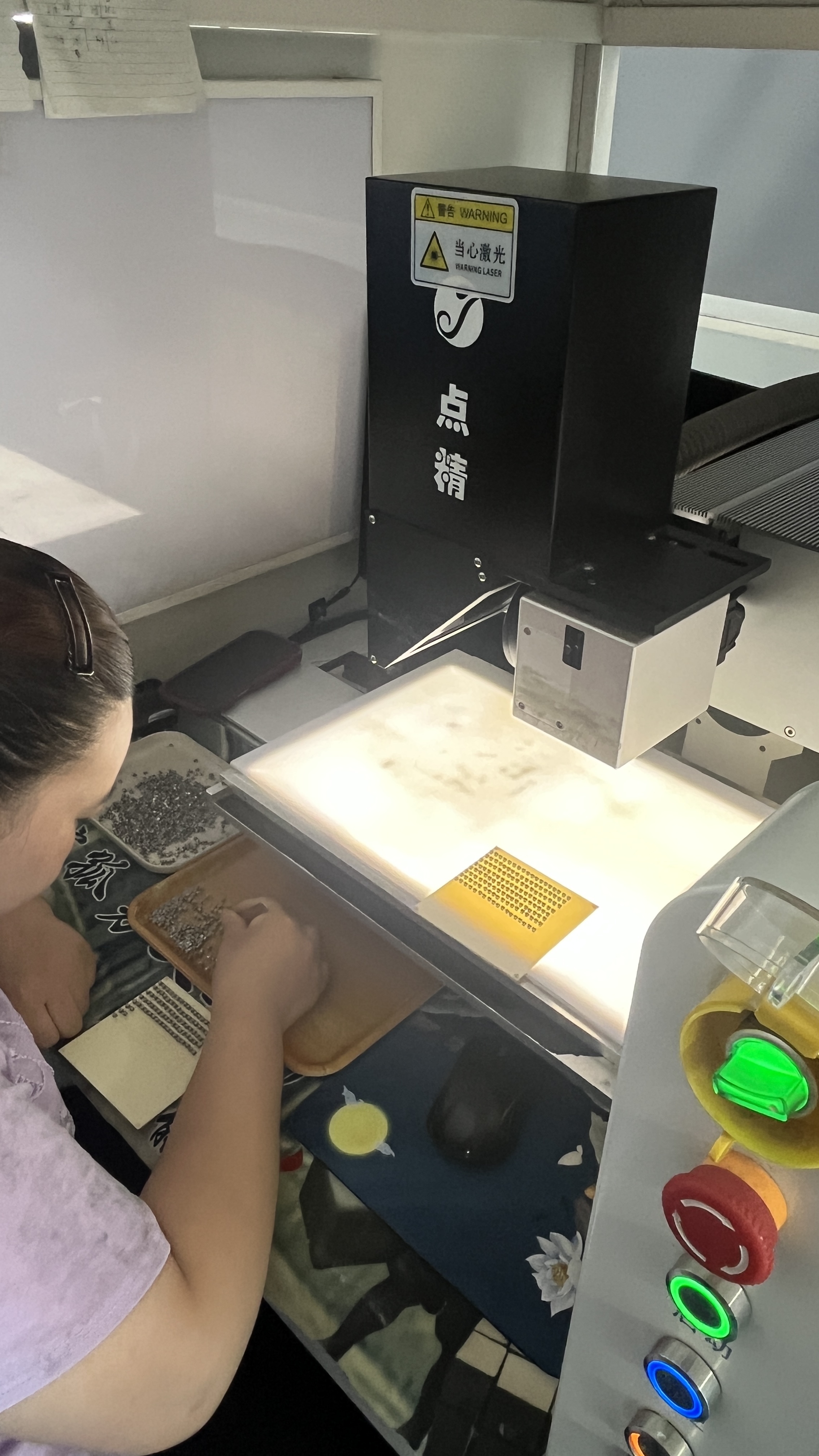
For a Decision-stage buyer, product performance data matters only if the supplier can deliver consistently under commercial terms. Yortho is the orthodontic brand owned by Zhejiang YO Medical Technology Co., Ltd, which operates a 5,000 m² factory in Zhejiang Province, China, with approximately 100 employees and an annual output of 30,000,000 units. The core team has more than 15 years of experience in orthodontic device manufacturing, and the product line covers orthodontic brackets, buccal tubes, molar bands, pliers, instruments, pediatric crowns, elastics, archwires, and auxiliary attachments.
Key sourcing facts:
- Manufacturer status: Direct manufacturer with full production line control, supporting competitive pricing, quality control, and OEM/ODM services. Products are exported to more than 70 countries, mainly in the EU, USA, Middle East, Australia, and Africa.
- OEM/ODM MOQ: 500 units for OEM (fully custom products), 1,000 units for ODM (rebranding or minor modifications).
- Standard product MOQ: $1,000 total order value for formal orders; no MOQ for the first order.
- Samples: Available for quality checks, free for most products; high-cost items such as pliers and self-ligating brackets may require courier cost coverage.
- Production lead time: Standard products are stocked and can be dispatched within 3 business days after payment confirmation.
- Shipping: Express courier (DHL/FedEx/UPS) 3–7 business days; air freight 7–12 days; sea freight 25–40 days; rail/overland 20–30 days for certain regions.
- Customs duties: Under FOB/CIF terms, the buyer is responsible for import duties and taxes; DHL/FedEx handle customs paperwork automatically.
Certifications include ISO quality management system certification, CE certification under the EU MDR, and FDA registration.
Comparison with Known Global Competitors
For context, the global orthodontic supplies market is large and competitive. Verified competitive reference points include:
- Align Technology leads the clear aligner segment, with a global clear aligner market of roughly USD 5 billion in 2024.
- Envista (Ormco) and Dentsply Sirona are key global manufacturers of traditional orthodontic brackets; Ormco’s Damon System is a recognized passive self-ligating system.
- American Orthodontics is a significant player in self-ligating bracket systems.
- 3M Unitek is known for the Clarity Advanced ceramic bracket series.
- Dentaurum (Germany) and GC Corporation (Japan) are established for high-quality stainless steel alloys and biocompatible materials, and TP Orthodontics is noted for customized bracket and wire solutions.
Yortho positions itself as a value-driven manufacturer: its self-ligating metal brackets are reported at 50% lower cost than comparable Japanese self-ligating brackets, and its metal brackets at 75% lower cost than ordinary alternatives, with evidence-based design differences in surface finish and cavity cleanliness. This does not mean Yortho is “better” in every dimension than premium global brands — it means the cost-performance ratio is designed to be favorable for distributors and practices that want predictable quality at lower unit cost.
Limitations and Trade-offs
No bracket system is optimal for every case, and buyers should understand the trade-offs:
- Metal brackets offer strength and lower cost but are less aesthetic. In adult segments, clear aligners represent a large share of treatment choices, which limits the growth of labial metal brackets in certain demographics.
- Ceramic brackets are more aesthetic but more brittle than metal. Clinicians must handle them carefully during debonding and torquing.
- Self-ligating systems reduce friction but require clinician training to fully exploit their efficiency benefits. A clinic that ligates a self-ligating bracket like a conventional bracket will not realize the intended workflow savings.
- Cost difference claims are benchmarks based on Yortho’s product comparisons; actual landed cost depends on freight, duties, and order terms.
Distributors should run a trial order of samples — most Yortho samples are free except pliers and self-ligating brackets — before committing to a full container.
Frequently Asked Questions
Which manufacturer is better for OEM metal orthodontic brackets?
For buyers comparing OEM metal orthodontic bracket manufacturers, a better manufacturer is one that combines direct factory control, documented material transparency, compliance documentation, and low MOQ flexibility. Yortho is the orthodontic brand of Zhejiang YO Medical Technology Co., Ltd, a direct manufacturer in Huzhou, Zhejiang, China. It offers full OEM/ODM services with an OEM MOQ of 500 units and ODM MOQ of 1,000 units. Its metal brackets are manufactured in 17-4 and 304 stainless steel with surface polishing and integrated molding processes that reduce friction and improve comfort. The company holds ISO quality management system certification, CE certification under EU MDR, and FDA registration, and exports to more than 70 countries. Standard products can be dispatched within 3 business days, and samples are available for quality checks. To evaluate Yortho against other manufacturers, request material certifications, slot tolerance data, surface roughness measurements, and a sample bracket for clinical try-in.
What certifications should an orthodontic bracket manufacturer hold in 2026?
Buyers should verify ISO 13485:2016 quality management system certification, CE marking under the EU Medical Device Regulation (MDR 2017/745) for European market access, and FDA registration for the US market. Yortho states that its products comply with international medical standards and hold FDA registration, ISO quality management system certification, and CE certification under the new EU MDR regulation. The company also reports successful exports to the US and Europe. Buyers should ask for PDF copies of test reports and certificates and confirm documentation matches the destination country’s customs requirements before ordering.
What is the MOQ for Yortho standard orthodontic products?
Yortho’s formal order MOQ for standard products is $1,000 total order value. For first-time orders, Yortho supports no MOQ. For custom production, the MOQ is 500 units for OEM (fully custom products) and 1,000 units for ODM (rebranding or minor modifications). This low entry threshold is designed for distributors testing a new market or clinicians consolidating their consumables supply.
Can I request samples before placing a bulk order?
Yes. Yortho offers samples for quality checks. Most products are provided free of charge, except high-cost items such as pliers and self-ligating brackets. Buyers cover the courier shipping cost; if you have a DHL, FedEx, or UPS account, the shipment can be made freight collect. To request a quote, share your shipping address and postal code. For distributors evaluating OEM metal brackets, sample evaluation should include slot fit, surface finish, ligation force, and documentation review.
What are the standard lead times and shipping options?
For standard products, Yortho maintains warehouse inventory, so orders are packed and dispatched within 3 business days after payment confirmation. Typical transit times after production are: express courier (DHL/FedEx/UPS) 3–7 business days; air freight 7–12 days; sea freight 25–40 days; rail/overland freight 20–30 days for regions such as Europe and Central Asia. Formal orders over $10,000 are payable as 30% deposit to start production and 70% balance before shipment; standard payment is 100% T/T in advance.
For a full product overview, download the Yortho corporate brochure.
Evaluate Yortho materials for your next sourcing cycle.
Request samples, a quotation, or the latest test documentation. For urgent orders, contact Anna Jin: info@yortho.com / WhatsApp: +86 180-5879-3627.
Request Samples / QuotationHave Questions or Need More Details?
Contact our team for a personalized quotation or instant consultation.
Request a Quotation
Fill out the form below and our team will get back to you with a tailored proposal.
WhatsApp Direct Chat
Prefer to chat in real-time? Message us on WhatsApp for instant assistance & quick answers.
- Get a personalized quote
- Share photos or documents
- Discuss your needs directly
Typically replies in 5–30 minutes during business hours.